1 leg · 1 level · W, FB, P, SR
The finger viaduct — the lightest structure in the MMC family. A services-only deployment: no freight, no maglev, no HVDC arms. The structural sizing is governed by water pipe weight, wind load, and seismic — all substantially smaller than the multi-service governing cases for MMC-VA, MMC-VB, or MMC-VC.
The lightest structure in the MMC viaduct family. A single central pylon carries a single platform-level deck supporting four services: a water pipe (the primary load), a power line for source-end and in-line pumping, a service rail for inspection and supply movement during operations — and during construction, the rail is the build mechanism itself. The viaduct extends itself outward along the corridor, span by span, off the live deck behind it. MMC-VD is the workhorse of the Sovereign Aqueduct Network water-capture programme — the finger viaducts that reach from the MMC-VA continental main aqueduct outward to individual northern river catchments.
| Configuration | Single-leg, single-level finger viaduct |
| Legs per pylon | 1 — single central leg |
| Pylon spacing | 25 m — 40 pylons per kilometre |
| Deck height | Variable — matches the MMC-VC tapered segment family; typical 8–20 m above ground |
| Span | 25 m — same as MMC-VC and MMC-VB |
| Foundation | 1 × 4 m OD ATS caisson, 10 m planning depth, ~10 ring segments + 1 anchor cap per pylon |
| Cutter head | 1 per pylon — sacrificial hybrid, stays in ground as permanent PT anchor |
| Tubular | 1 × 7″ × 29 ppf L80 13Cr API 5CT — sized for the lighter single-leg water-corridor load case; reduced diameter from MMC-VC's 13.375″, 13Cr alloy retained for material-family commonality across the MMC platform |
| Column | P1 tapered segments, single leg, same Megafactory family — 2 segments per pylon for typical 8 m height; more for taller deployments |
| Transverse cap beam | Precast concrete crossbeam atop each pylon, perpendicular to corridor axis, with integrated saddles for water pipe, service rail, and services trough via P#7 rib — 1 per pylon |
| Platform deck | Single P#7 precast concrete module per 25 m span, sitting on the transverse cap beams of adjacent pylons |
| Deck services | Water pipe (diameter project-specific), service rail, power line, fibre & SCADA conduit, transmission and ancillary service trough |
| Self-building deployment | Yes — the service rail is the construction mechanism. The viaduct extends itself span by span along the corridor. |
| Megafactory family | Strict subset of MMC-VC modules — same caisson rings, same column segments, same Megafactory production line |
MMC-VD is the lightest expression of the MMC platform. The structure is single-purpose — built to carry water and its supporting services, nothing else. No freight, no maglev, no HVDC arms, no hyperloop reservation. The structural sizing is governed by the water pipe weight, wind load, and seismic — all substantially smaller than the multi-service governing cases for MMC-VA, MMC-VB, or MMC-VC. The result is the smallest pylon, the shallowest foundation requirement, and the lowest per-kilometre cost in the MMC structure catalogue.
MMC-VD's economic argument rests on its position as a strict subset of MMC-VC and below. The Megafactory is dimensioned for Phase 0 MMC-VB; the establishment cost is paid by Phase 0. MMC-VD modules are a strict subset of MMC-VC modules — same caisson rings, same column segments, same anchor caps, same tubular. MMC-VD production is incremental on a factory already running. The Sovereign Aqueduct Network deployment (1,500–3,000 km of MMC-VD across SBC #3 and SBC #5 northern catchment corridors) is absorbed by the same production lines that run for MMC-VC and MMC-VB.
The self-building deployment is the defining install advantage. As the viaduct advances from the MMC-VA junction outward along the corridor, a service train works from the deck of the already-built section: drill the next foundation, set the next pylon, lift the next deck module, lay the next length of service rail, advance the train onto the freshly-laid rail. Each cycle adds one pylon span and lays the rail that the next cycle works from. The same service train, after the viaduct enters service, becomes the operations-phase rolling stock — carrying inspection personnel, maintenance crews, and component replacements along the length of the corridor.
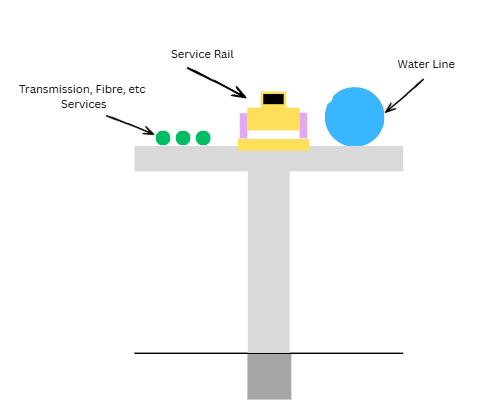
MMC-VD is deployed wherever the Sovereign Aqueduct Network requires a finger to reach a water source or wherever last-mile water delivery is needed. The continental water-capture programme captures monsoon water from multiple distributed river catchments; each catchment needs its own finger viaduct reaching from the MMC-VA continental trunk into the source. The fingers fanning out from the main corridor on the published Sovereign Aqueduct Network maps are MMC-VD deployments.
The engineering of MMC-VD is documented alongside the rest of the MMC platform memo series. The Models page is the catalogue — the Library is the engineering depth — the Costs page is the unit-rate cost engineering.
MMC-VD is covered by the Architectural Framework (Patent 4) and the single-leg topside configurations referenced in Patent 6. The single-level finger viaduct architecture leverages the same renewable tubular tension element as MMC-VC, sized down to the lighter water-corridor load case — one 7″ tubular per pylon, one anchor receptacle in the cutter head, one tensioning operation at the pylon cap. The self-building deployment methodology — where the service rail on the deck is also the construction mechanism — emerges directly from Patent 4's modular precast pylon segment architecture combined with the corridor-as-its-own-supply-chain principle described in Memo 6 (Build).