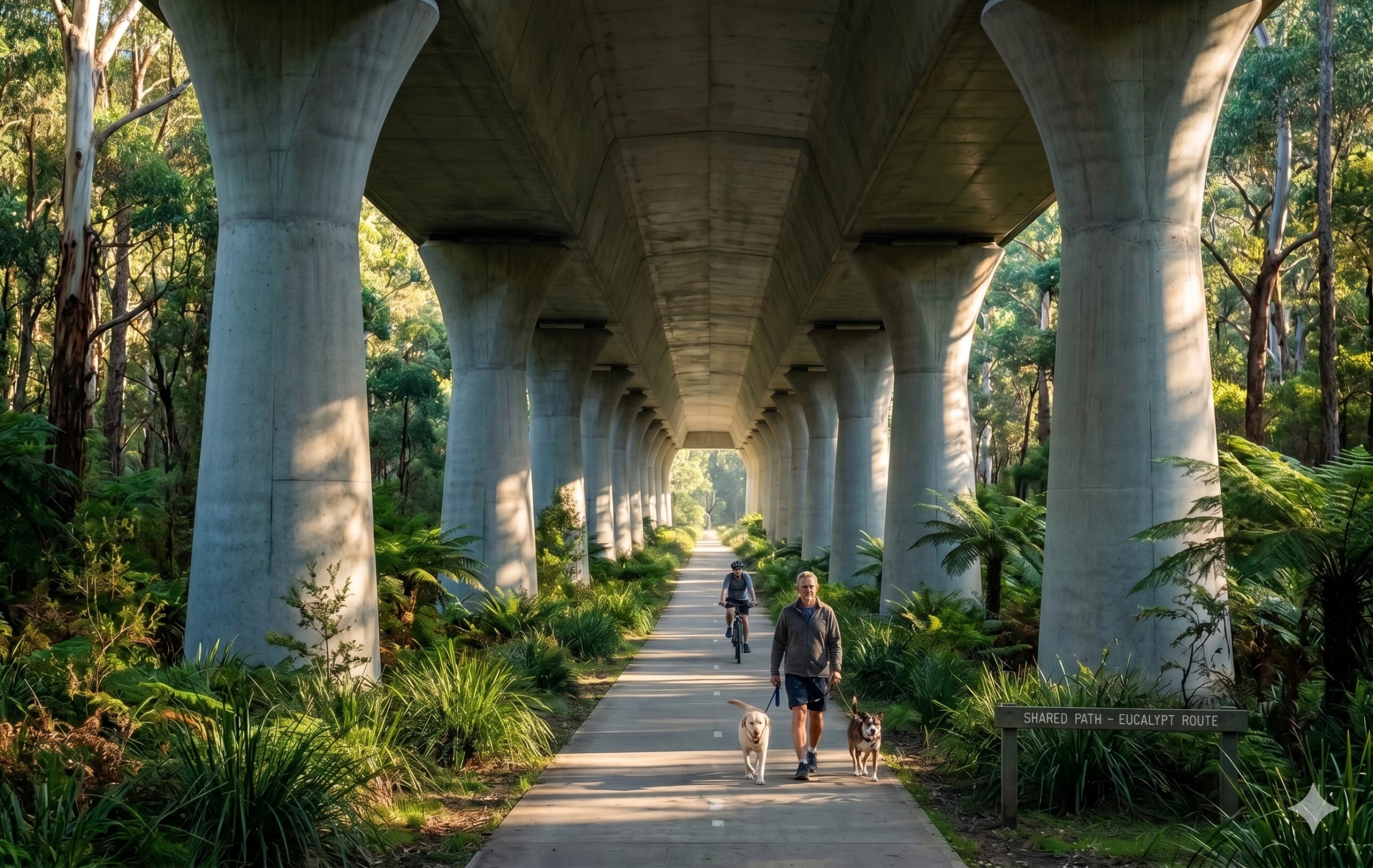
Elevated multi-modal infrastructure does not just avoid the environmental damage of at-grade infrastructure. It actively creates a continuous environmental asset underneath: a wildlife corridor for ecosystem connectivity, a sheltered shared path for cycling and walking, and a structural footprint substantially smaller than equivalent at-grade infrastructure. Where terrain allows, the corridor rises to 10 metres and above — opening the landscape to horizon views along one of the great linear paths of the continent.
Conventional at-grade infrastructure — motorways, rail lines, transmission corridors, pipelines — fragments habitat continuously along its entire length. Wildlife crossings are constructed at engineered intervals; everywhere else, the infrastructure is a barrier. Land disturbance is continuous: earthworks along the entire route, drainage modifications, impervious surfaces, fencing, edge habitats degraded by noise and pollution.
Elevated infrastructure has a fundamentally different environmental profile. Land disturbance is concentrated at pylon foundation locations — a few square metres at each pylon, separated by pylon spacing of typically 30 to 60 metres along the corridor. Between pylons, the ground beneath the elevated structure remains intact: native vegetation, ground hydrology, soil structure, micro-topography. The corridor passes over the landscape rather than dividing it.
The cumulative environmental difference at continental scale is substantial. A 2,000-kilometre at-grade corridor disturbs a continuous 50- to 100-metre-wide swathe of land, totalling 100 to 200 square kilometres of fragmented habitat. The same corridor deployed elevated disturbs perhaps 5 to 10 square kilometres at concentrated pylon locations, with the remaining land area essentially undisturbed.
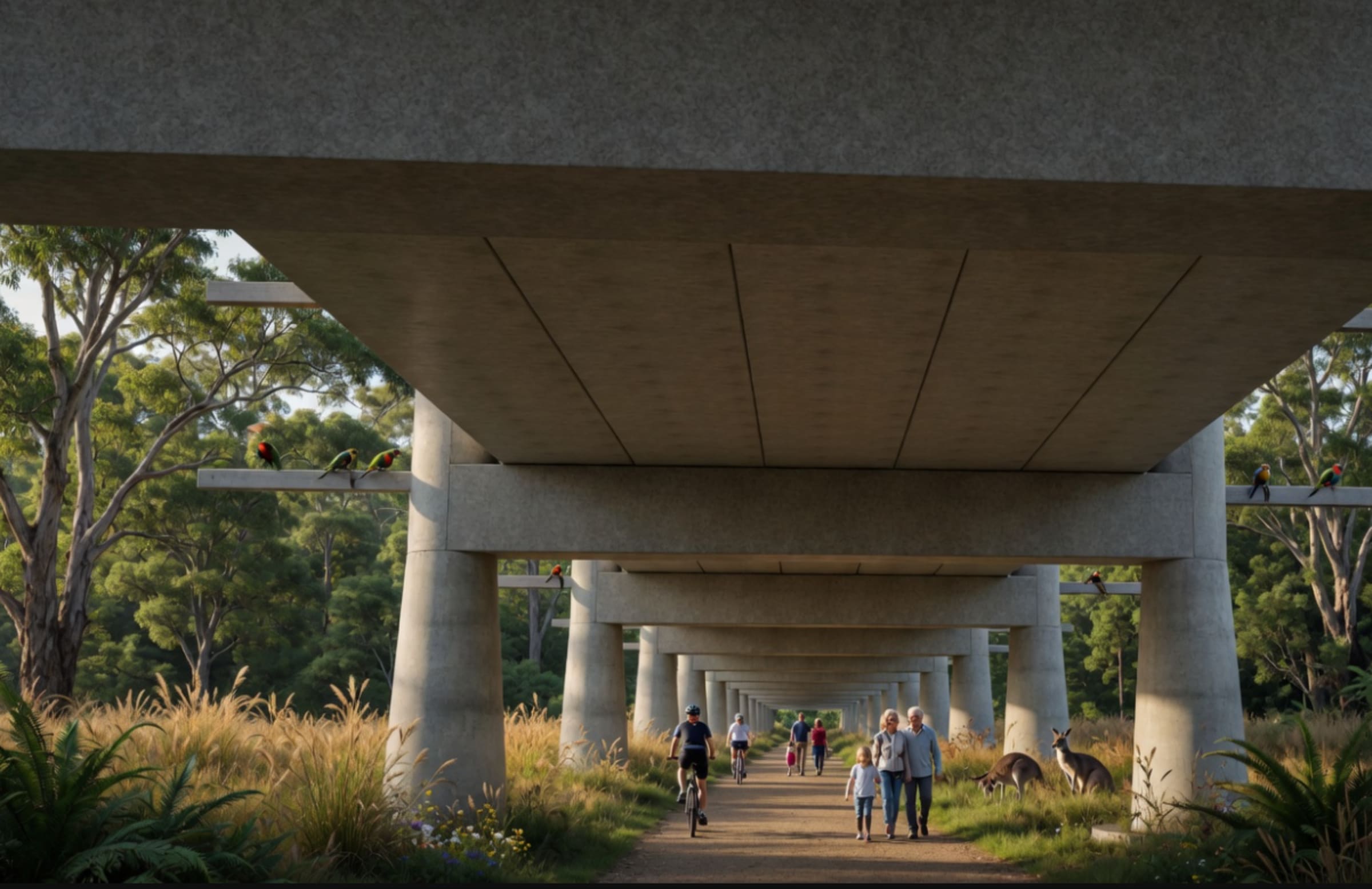
The under-viaduct corridor functions as a continuous wildlife passage running the full length of the deployment. Australian native species — kangaroos, emus, wombats, dingoes, smaller mammals, reptiles — move freely beneath the elevated structure, with no fencing barriers, no road kill zones, no fragmented habitat patches. Drought-driven movement patterns, seasonal migration, and territorial range across thousands of kilometres remain intact.
The corridor's natural underside provides shade, water collection, and shelter — the structural geometry creates a microhabitat band that may actively benefit some species relative to the surrounding open landscape, particularly in arid Australian conditions.
Continental habitat connectivity is one of the structural challenges of conservation in industrialised nations. Habitat fragments separated by infrastructure barriers degrade over decades through reduced gene flow, smaller population sizes, and disrupted ecological processes. The Multi-Modal Corridor's elevated geometry maintains habitat connectivity along its entire length — and where the corridor crosses existing fragmented habitats, it can actively reconnect previously isolated patches.
Australian conservation regulators, environmental impact assessment processes, and ecological clearance frameworks have been seeking infrastructure architectures that solve the habitat fragmentation problem rather than mitigating it. Elevated multi-modal corridors offer an architectural solution rather than a mitigation regime.
The shared path beneath the SBC corridor — sheltered, continuous, and open to forest on both sides. The corridor passes above the landscape; the landscape continues beneath. Variable elevation — from 6m in sheltered forest sections to 10m and above on open ridgelines — creates moments of expansive horizon views along the path.
The under-viaduct corridor naturally accommodates a continuous active transport network — bike paths, walking trails, equestrian routes — running the full length of the deployment beneath the elevated structure. The path is sheltered from sun and rain by the viaduct deck above. The path is separated from vehicle traffic, freight rail, and other moving infrastructure by the structural elevation.
For long-distance cycling tourism, recreational walking, and active commuting in regional areas, the under-viaduct path provides infrastructure that is essentially impossible to retrofit to existing transport corridors at comparable cost. The path is built into the corridor's structural footprint at construction time, with no additional land acquisition, no separate route planning, no parallel infrastructure programme.
The corridor's elevation varies with terrain and community intent. At 6 metres in sheltered forest sections, the path is cool, shaded, and intimate — a green tunnel through the bush. Where terrain opens and community benefit aligns, the corridor rises to 10 metres and above, the canopy drops away, and the path opens to unobstructed views across ranges, valleys, and horizons.
This rhythm — shelter and openness, intimacy and scale — makes the under-viaduct path an experience in its own right. Communities along the corridor gain not just a transport connection, but one of the great linear walks of the continent. Long-distance cycling routes generate substantial regional tourism revenue. A continental-scale under-viaduct path inherits these economics across 2,423km of corridor.
Concentrated pylon footprints disturb ground hydrology far less than continuous at-grade earthworks. Native drainage patterns remain largely intact. Watercourses crossing the corridor route pass beneath the elevated structure without diversion, culverting, or bridging works.
Service operations occur at deck height — typically 8 to 25 metres above ground — putting lighting and operational noise sources well clear of ground-level habitat. The under-viaduct space remains a low-disturbance environment for wildlife and active transport users.
The platform's inspectable, renewable tension element architecture provides extended operational life through replaceable structural elements. End-of-life pylon segments and decks are precast concrete suitable for crushed-concrete recycling. The architecture supports operational longevity and end-of-life material recovery.
The under-viaduct corridor is not a residual space — it is a designed asset. Forest continues to the base of the columns. The shared path runs the full corridor length, sheltered above and open to native bush on both sides. Wildlife moves freely. The landscape is continuous.
Visualisation — shared path beneath the SBC corridor in Australian bush. The corridor passes above; the landscape continues beneath.