A Global Infrastructure Platform

Continental infrastructure, delivered on cost and on time, to a single global standard.

Multi-Modal Corridors is a productised modular elevated infrastructure platform for the conveyance of services — passenger, freight, energy, water, gas, fibre — across continental distances. The architectural standard by which the world's continental infrastructure — moving goods, energy, and information across thousands of kilometres — can be built worldwide, at scale, to a single specification.

Patent Family Seven Australian Provisional Patents
Filed 24 April – 7 May 2026
Sovereign IP Commonwealth of Australia

Productised Infrastructure at Continental Scale.

The world's continental infrastructure projects routinely overrun cost and schedule by a factor of two to four. The cause is structural: each project is engineered bespoke, every metre is a fresh discovery, and economies of scale never accrue. The Multi-Modal Corridors platform addresses this directly.

It is to elevated continental infrastructure what the Tunnel Boring Machine is to subterranean infrastructure: a factory-built industrial system that delivers predictable per-kilometre cost, deployed at the pace of crane lifts rather than at the pace of ground-level problem-solving. Modular precast pylon segments are manufactured in mega factories. Foundations are drilled by purpose-built rigs to standardised geometry. Decks and cross-arms are pre-engineered for a fixed set of configurations. Construction proceeds by parallel-team deployment along the corridor.

The TBM industry did not choose modularity for elegance. It was forced into modularity by the engineering reality of building a fifteen-metre-diameter, two-thousand-tonne machine underground — there was no other way. Cutter heads, tunnel segments, drive systems, all manufactured in factories, transported to the working face, assembled by trained crews to standardised methodology. The forced productisation of the machinery became the value: predictable per-metre cost, predictable schedule, fleet-deployable methodology. The Multi-Modal Corridors platform makes the same architectural choice deliberately, in a domain where bespoke construction is still the norm above ground.

But the TBM analogy is incomplete. TBMs productised the machinery of tunnel construction; they did not productise what lies in the ground that the machinery cuts through. Tunnel projects worldwide continue to suffer cost overruns and schedule blow-outs because the subsurface itself remains the unknown — unexpected rock conditions, water inflows, fault zones, voids, stress states, but also existing utilities, foundations of demolished buildings, abandoned infrastructure, contaminated soil, and archaeological remains. London's Crossrail, Seattle's SR-99 (where a buried steel pipe stopped the world's largest tunnel boring machine for two years), Sydney Metro, California High-Speed Rail, Melbourne's West Gate Tunnel — even with mature TBM technology, every major tunnelling project still encounters subsurface conditions, natural or human-made, that planning could not fully predict. The Multi-Modal Corridors platform avoids this entirely. Building above the ground rather than through it is what removes the cost and schedule blow-outs that these projects document. Foundations are drilled at known engineered locations to known engineered depths; the corridor structure passes above whatever lies between them. The platform productises the machinery and removes the subsurface from the cost equation.

See the cost-overrun record on corridor megaprojects →

The architecture is scale-independent and configuration-independent. The same primitives produce a wooden-pole-replacement distribution structure for a rural electricity network, an ultra-high-voltage transmission tower carrying 765 kV across a continent, or a multi-modal viaduct carrying maglev passenger service alongside electric freight, HVDC, water, gas, and sovereign fibre. The configuration changes; the architecture does not.
The MMC Architecture.

Seven provisional patents. One architectural foundation. From distribution-pole scale to ultra-high-voltage transmission to continental multi-modal viaducts — a single productised modular system, scale-independent and application-independent, deployable worldwide to a single standard.

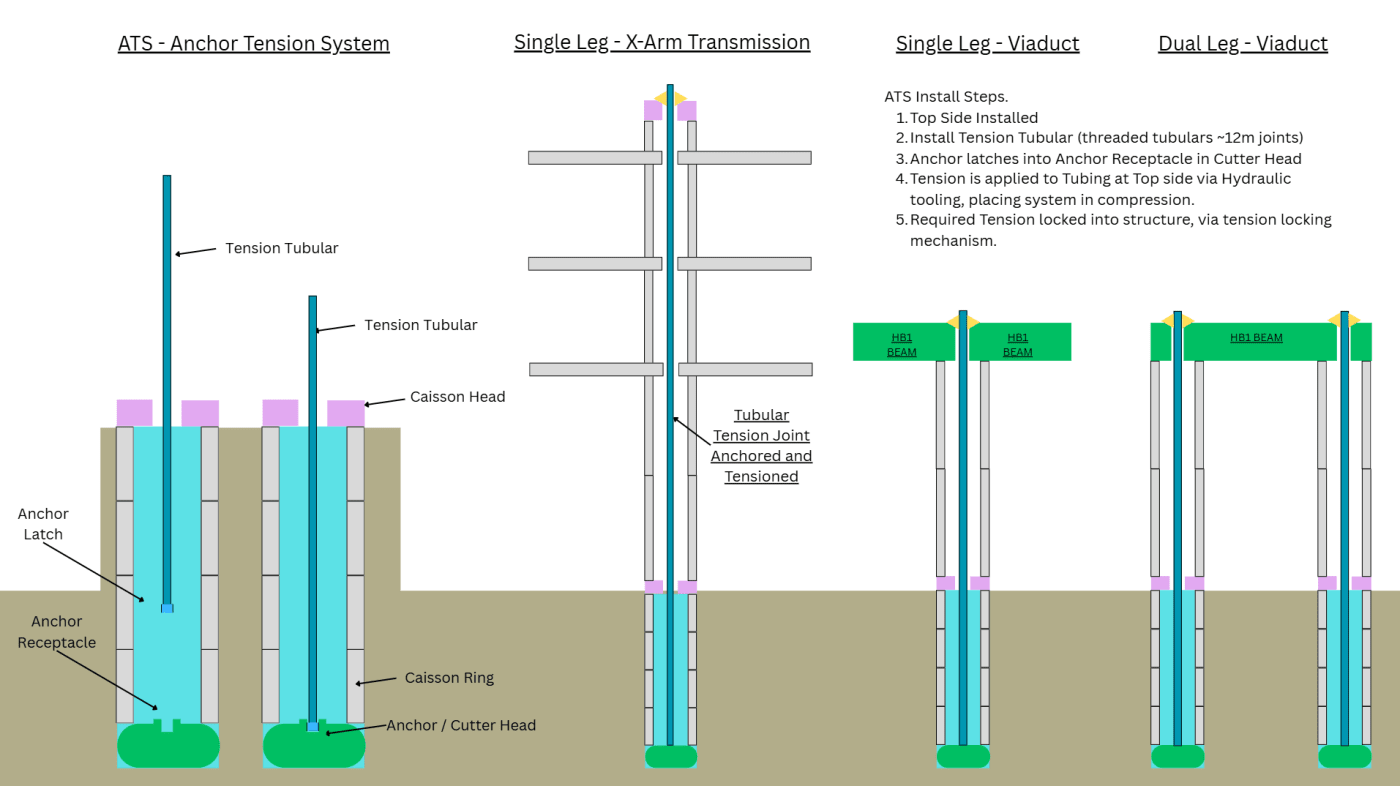
MMC architectural primitives — the Anchor Tension System (ATS) foundation showing tension tubular, caisson rings, anchor latch, anchor receptacle, and cutter head; with three topside configurations: Single-Leg X-Arm Transmission, Single-Leg Viaduct, and Dual-Leg Viaduct
The MMC architecture in detail. Left: the Anchor Tension System (ATS) — drilled-and-grouted caisson with cutter head anchor at foundation depth, tension tubular running up the centre, latching into the anchor receptacle, tensioned at the caisson head. Right: three topside configurations on the same ATS foundation — single-leg cross-arm transmission, single-leg viaduct with HB1 cap beam, and dual-leg viaduct with HB1 cap beam between two pylons. ATS install: top side built first; tension tubular installed in ~12m threaded joints; anchor latches into the cutter head receptacle; hydraulic tooling at the top side applies tension, putting the system into compression; tension is locked into the structure via the tension locking mechanism.

The architecture is built around a continuous tensioning column running from a cutter head anchor at foundation depth to the pylon cap at the structure's upper end. This is the Anchor Tension System (ATS) — the foundation feature within the MMC patent family. Modular precast concrete pylon segments stack vertically with interlocking joints that align segments precisely and absorb structural movement. The tubular tension element pre-loads the entire stack in compression, locking pylon segments, cross-arms (or decks), and pylon cap into a single locked structure.

The tubular itself is renewable — replaceable during operational life through standard intervention — giving the architecture extended operational life with replaceable components — unaffected by the steel-reinforcement corrosion that limits the life of conventional concrete structures. The same architectural framework supports both single-pylon configurations (transmission and distribution towers) and paired-pylon configurations (multi-modal viaduct corridors) within a single coherent platform.

How the Platform is Organised.

The Multi-Modal Corridors platform separates the structure (the productised infrastructure itself) from the services (what runs on it). This is the same logic that made the shipping container work: the box and the handling interface were standardised, but who manufactured the boxes, who shipped them, and who handled them remained competitive forever. The structure is the cooperation; the services compete within it.

01 / The Platform Itself

THE PLATFORM

The three-axis configurator: Foundation, Legs, Topside. The modular building blocks — a fixed set of design variables that combine to produce every deployment configuration.

02 / What Runs On It

SERVICES

Ten conveyed services — HVDC transmission, maglev passenger, electric freight, water, gas, hydrogen, fibre, hyperloop, service rail. Each its own engineering category with its own standards work.

03 / The Numbers

ECONOMICS

The economic case for Phase 0 Melbourne–Brisbane — 2,423km, ten services, one structure. Detailed cost modelling and revenue projections forthcoming pending review.

04 / How It Gets Built

BUILD

The Megafactory Method. Assembly-line precast concrete at automotive rates, foundation drilling at production rate, parallel-team corridor assembly. The industrial system that delivers on cost and on time.

05 / What Sits Beneath

ENVIRONMENTAL

The under-viaduct corridor as a continuous environmental asset. Wildlife passage, shared cycling and walking path, reduced land disturbance, zero habitat fragmentation between pylons.

06 / The Catalogue

MODELS

The settled MMC family — MMC-VA, MMC-VB, MMC-VC viaducts and MMC-TA, MMC-TB, MMC-TB Guyed transmission towers. The named products built on the platform configurations.

07 / The Technical Evidence

LIBRARY

Engineering memo series for the MMC system — Megafactory specification, transmission tower sizing, foundation anchor architecture, viaduct engineering, and continental viaduct configurations.

08 / Deployments

PROJECTS

Sovereign Build Corporation programme for Australia — Phase 0 Melbourne–Brisbane spine, seven Phase 0 spurs covering the populated east, and three continental phases delivering SBC #1 through #6. Future deployments worldwide.

09 / The Intellectual Property

PATENTS

Seven Australian Provisional Patents covering the architectural primitives — Foundation Core, Integrated Foundation, Foundation Drilling System, Architectural Framework, Multimodal Viaduct Topside, Pole and Tower Architecture, and Assembly-Line Precast Manufacturing.

10 / Visualisations

GALLERY

Concept visualisations, AI-generated imagery, and current design work. Two galleries — Visualisations and Current Designs — showing the MMC platform across its full configuration space.

11 / Engagement

CONTACT

Direct contact for national governments, infrastructure ministries, engineering authorities, capital partners, and industry organisations whose engagement can advance the global standard.

Elevated is the architecture of single-stroke decision.

At-Grade and Tunnelled

Each metre encounters new ground-level problems: utilities to relocate, traffic to maintain, drainage to redirect, businesses to keep accessible, heritage requirements to navigate. Every problem is identified, escalated, resolved, and signed off before construction proceeds. Canberra Light Rail Stage 2A — 2.5 kilometres of at-grade urban rail — has been under construction since 2022 and remains incomplete, four years on.

Elevated and Productised

Construction proceeds above all of it, at the pace of crane lifts. Pylon segments and decks are precast in mega factories in parallel with foundation installation. Modular segments are stacked, captured, and tensioned as a coordinated industrial sequence. Productised elevated viaduct deployment scales by parallel-team deployment along the corridor, decoupled from at-grade conditions.

At-grade is the architecture of repeated discovery. Elevated is the architecture of single-stroke decision.

The cheapest, fastest, longest-lasting solution — even for single-service deployment.

A nation building a single new HVDC line would conventionally erect bespoke steel lattice towers along bespoke foundations, sourced from project-specific procurement, assembled at site by specialist crews, with operational life of thirty to fifty years before significant refurbishment.

The same nation, building the same single HVDC line as a Multi-Modal Corridor, would deploy productised modular pylon segments from regional manufacturing factories, founded on standard ATS caisson geometry, assembled by parallel teams along the corridor at productised pace, with extended operational life through the inspectable, renewable tension element architecture. The HVDC line is the same line. The cost is lower, the schedule is shorter, the operational life is longer, and the corridor architecture includes structural provision for additional services — fibre, water, future technologies — to be added when and as the host nation requires, with no additional structural intervention.

The proposition is not "consider whether you want a multi-modal corridor." It is: build any new continental infrastructure as a Multi-Modal Corridor, because the architecture delivers the immediate requirement at lower cost than the bespoke alternative, and includes future capacity at no additional structural cost.

Multi-modal becomes the default. Single-service becomes the special case. Every kilometre of new continental infrastructure becomes part of the same global standard — manufactured to the same specification, maintained by the same protocols, expandable to additional services on the same architecture.