The Platform Itself

Foundation. Legs. Topside.

Three independent design variables. A fixed set of options. A set of modular building blocks that combine to produce every deployment configuration the platform is capable of — from a low-voltage distribution pole through an ultra-high-voltage transmission tower to a continental multi-modal viaduct corridor carrying ten services on a single elevated structure.

Three Axes. Choose One Option from Each.

The structure of every Multi-Modal Corridors deployment is defined by three independent choices. The foundation type. The leg configuration. The topside arrangement. The same productised manufacturing system produces every combination, configured at the order line rather than at the factory floor.

Axis 01
FOUNDATION
  • ATS — Anchor Tension System Drilled-and-grouted caisson with cutter head anchor and inspectable, renewable tubular tension column. Extended operational life through replaceable tension element. Scale-independent across all current applications.
Axis 02
LEGS
  • Single-Leg One pylon stack at each location. Suitable for transmission towers, distribution poles, communications towers, lighting poles — applications where the pylon carries cross-arms extending out to the sides.
  • Two-Leg Two parallel pylon stacks with engineered spacing. Suitable for multi-modal viaducts, multi-deck topside configurations, and any deployment requiring a wider topside structure for service-bearing decks rather than point-load cross-arms.
Axis 03
TOPSIDE
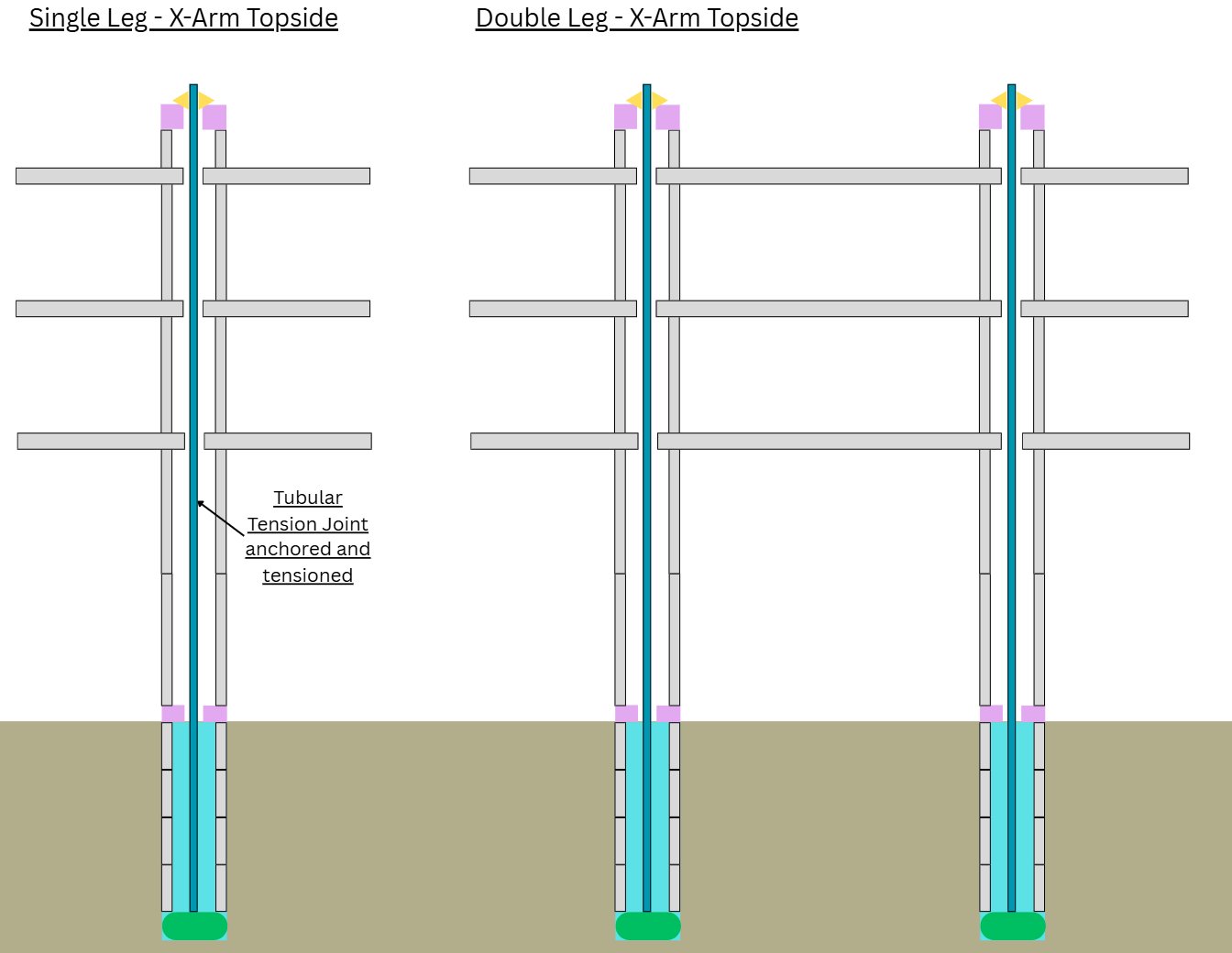
  • Cross-Arm Topside Cross-arms captured between pylon segments and held in place by the tensioned tubular passing through them. Carries conductors for transmission and distribution applications, antennas for communications towers, lighting fixtures, signal equipment.
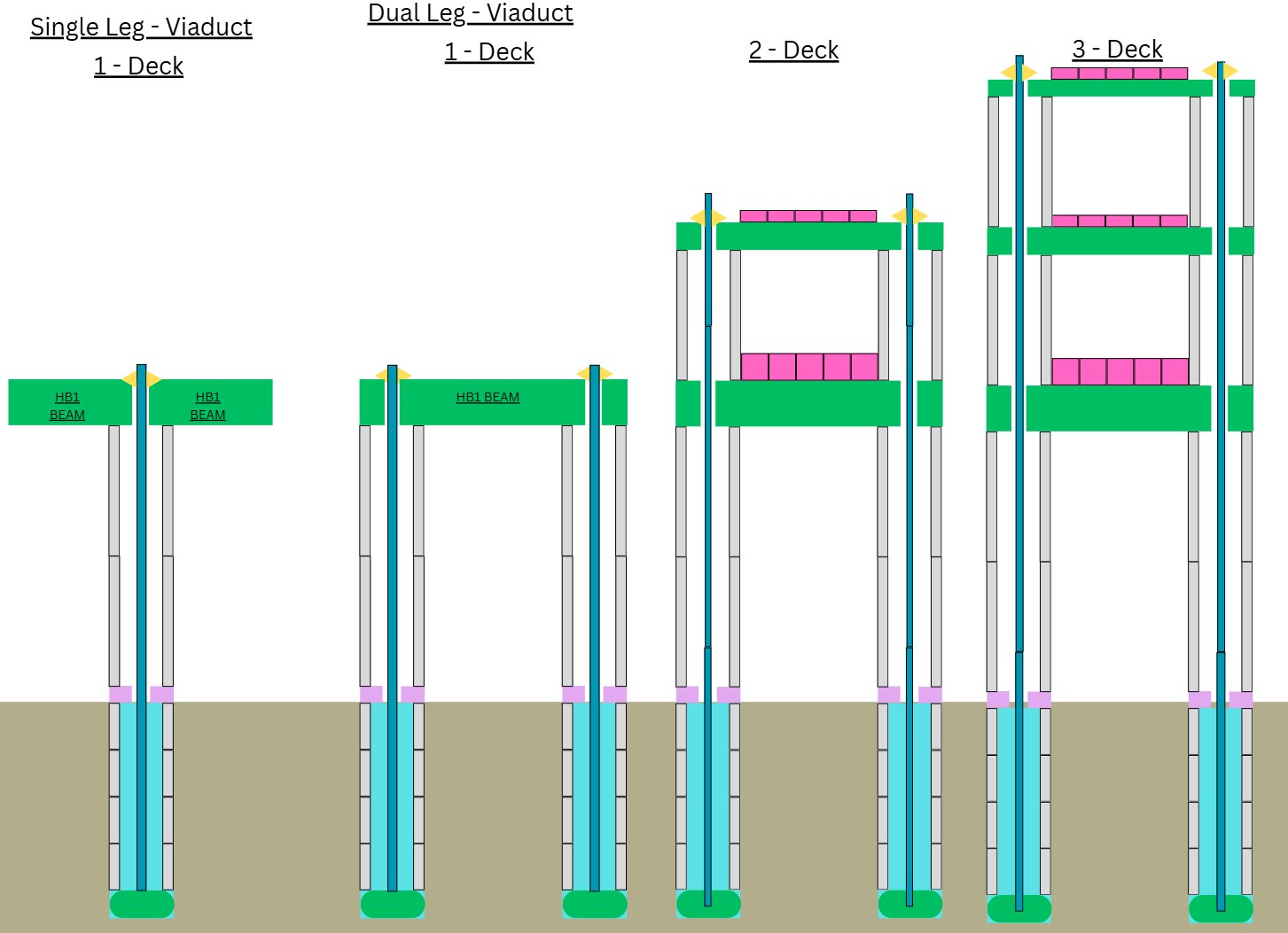
  • Single-Deck Viaduct One service deck spanning between paired pylons. The deck can carry one or more services side by side at the same level — for example HVDC plus service rail, freight rail plus pipelines, or any combination compatible with a single deck level. The defining feature is the single deck level; what runs on it is configured per deployment.
  • Multi-Deck Multi-Service Viaduct Multiple service decks at engineered heights between paired pylons. Carries the full multi-modal service combination — passenger maglev, electrified freight, HVDC, water, gas, fibre, hyperloop reservation, road, service rail — on a single corridor structure.

The configurator describes what the architecture is currently capable of. The architectural framework supports additional options on each axis as deployment categories require: future foundation types for marine and rock applications, future leg configurations for special-span requirements, future topside types as new services and applications mature.

How the Three Axes Combine.

Every Multi-Modal Corridors deployment is a combination — one option from each axis. The same productised infrastructure produces every combination through the same Mega Factory Method (per the Manufacturing page); the configuration determines what the deployment looks like at the topside.

Configurations vs Models. The configurations below describe the architectural possibilities — what the platform can be configured as. The named MMC family members built on these configurations — MMC-VA, MMC-VB, MMC-VC, MMC-TA, MMC-TB, MMC-TB Guyed — are catalogued separately as the settled products. See the Models page →

Distribution Pole
ATS Single-Leg Cross-Arm Topside
Replaces wooden distribution poles. Extended operational life, fire resistance, dielectric pylon material simplifying insulator architecture. Scale-appropriate small-diameter pylon segments.
Transmission Tower
ATS Single-Leg Cross-Arm Topside
Replaces steel lattice transmission towers across the full voltage range from 66 kV to 765 kV+, including HVDC at ±800 kV and ±1100 kV. Multi-circuit cross-arm configurations engineered for clearance and electromagnetic compatibility. Single pylon covers approximately 80% of continental transmission deployment range.
Dual-Tower Transmission Line
ATS Two-Leg Portal Cross-Arm Topside
Two standard MMC pylons coupled by three transverse cross-beams captured through both pylon stacks, forming a portal frame with moment continuity. Used for high-voltage strain towers, river crossings, and heavy conductor loading where a single pylon's capacity is exceeded. Both pylons are the same standard 4m base production unit — no bespoke fabrication required.
Single-Service Viaduct (e.g. Road or Rail Corridor)
ATS Two-Leg Single-Deck Viaduct
A dedicated road or rail corridor deployed as a single-service elevated viaduct. Foundation, structural primitives, and construction methodology identical to multi-modal deployments — only the topside is configured for the specific service. Future service slots remain structurally available for activation without additional civil works.
Multi-Modal Continental Corridor
ATS Two-Leg Multi-Deck Multi-Service Viaduct
The headline configuration. Carries the full service combination — passenger maglev, electrified freight, HVDC transmission, water, gas, fibre, hyperloop reservation, road, service rail — on a single elevated structure. Multiple decks at engineered heights, with service slots reserved structurally for future technologies.
Communications Tower
ATS Single-Leg Cross-Arm Topside
Same architecture as transmission, with cross-arm configuration adapted for antenna mounting, dish placement, and communication equipment. Ornamental pylon cap or head accommodating top-mounted antennas.
The Configurator, Illustrated.

The diagrams below show the architectural primitives across all current topside configurations. The foundation, pylon segments, caisson, tubular tension column, and cutter head anchor are constant across every configuration. What varies is the topside arrangement.

Single Leg X-Arm Topside and Double Leg X-Arm Topside — transmission tower configurations
X-Arm Topside configurations — Single Leg (transmission and distribution tower, left) and Double Leg (dual-tower portal frame for strain towers and high-load crossings, right). Same standard pylon production unit in both. Tubular tension joint anchored through pylon stack to cutter head at foundation depth.
Viaduct configurations — Single Leg 1-Deck, Dual Leg 1-Deck, 2-Deck, and 3-Deck
Viaduct Topside configurations — Single Leg Single-Deck (road or rail), Dual Leg Single-Deck, Dual Leg 2-Deck (Phase 0 MMC-VB — freight deck at 6m + maglev deck at 17m), and Dual Leg 3-Deck (full multi-modal). HB1 transverse cap beam in green. Upper deck girders and deck elements in pink. Same caisson foundation and pylon segment family across all configurations.

Each Axis is Protected.

The three axes of the configurator map directly to the MMC Patent Family. The foundation axis is protected by the Foundation Core, Integrated Foundation, and Foundation Drilling System patents. The leg architecture is protected by the Architectural Framework patent. The topside configurations are protected by the Pole and Tower Architecture patent (cross-arm topside) and the Multimodal Viaduct Topside patent (single-deck and multi-deck viaduct topsides).

Foundation

Patents 1, 2, 3 — Foundation Core, Integrated Foundation, Foundation Drilling System. Patent family →

Legs

Patent 4 — Architectural Framework. Modular precast pylon segments with pin-and-box joint geometry. Patent 4 detail →

Topside

Patents 5, 6 — Multimodal Viaduct Topside, Pole and Tower Architecture. Patent 5 →   Patent 6 →