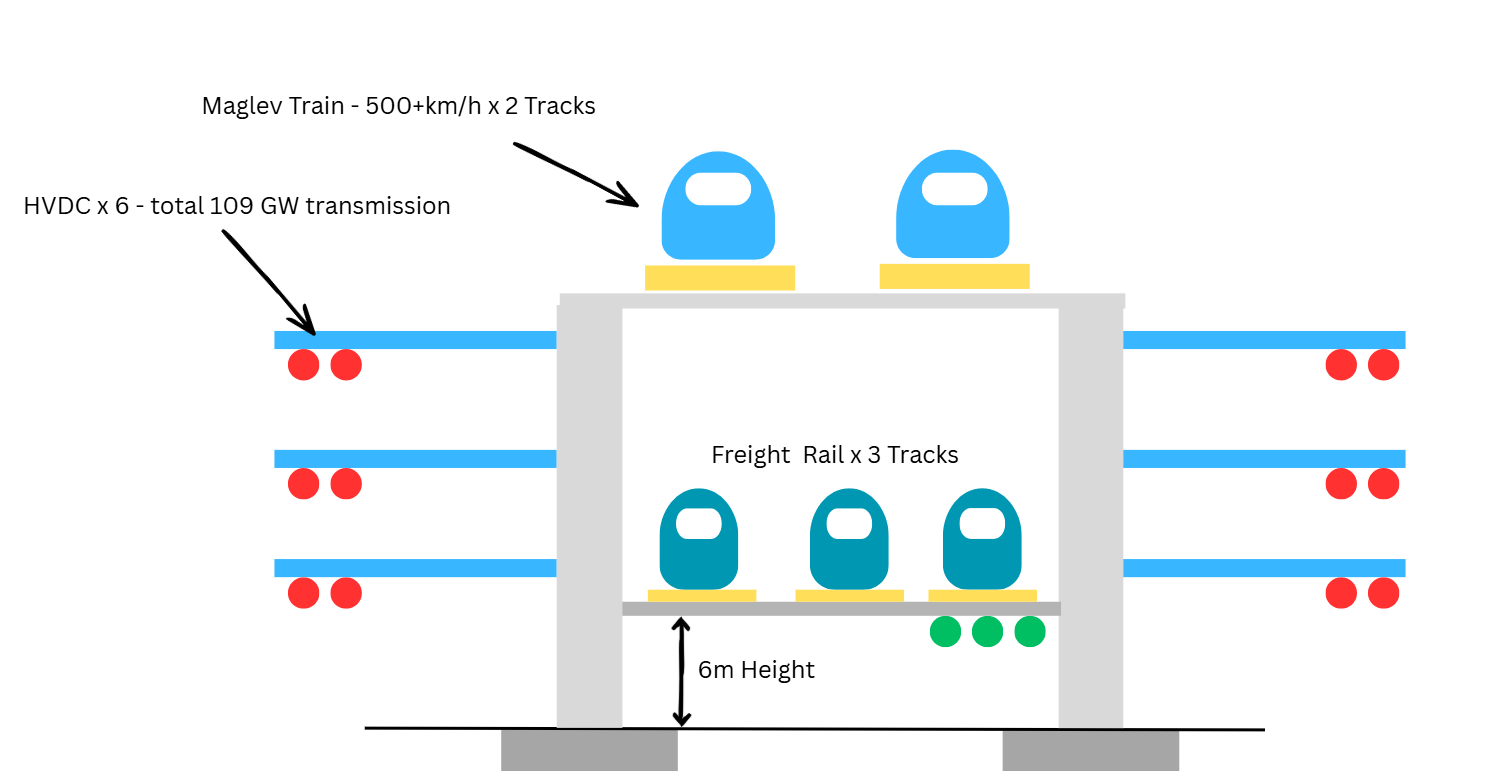
The Phase 0 corridor standard. Two legs, two decks — freight at 6m, maglev at 17m — with HVDC arms, gas, hydrogen, fibre, and water services on a single dual-leg structure. The Phase 0 Melbourne–Brisbane corridor (2,423km) and the Phase 0-1 Hunter spur (111km) are built to MMC-VB standard. Stage 1 commissions freight in Stage 1, before the upper structure; Stage 2 maglev is added on the running freight line.
Specification
MMC-VB at a glance.
Configuration
Dual-leg, two-deck multi-service viaduct
Legs per pylon
2 — left leg and right leg
Leg spacing
8.0m centre-to-centre; ~17m total corridor width including overhang
Deck levels
2 — Stage 1 freight (6m), Stage 2 maglev (17m)
Span
25m standard
Foundation
2 × 4m OD ATS caisson, 15m planning depth, ~270t per pylon (30 ring segments + 2 caisson heads)
Broken wire longitudinal load — ~420kN per pole at HVDC arm-to-HB1 connection
MMC-VB — two-leg, two-deck multimodal viaduct configuration (Phase 0 standard). Pre-feasibility illustration. SketchUp engineering renders are in production.
Configuration
How MMC-VB is built on the platform.
MMC-VB is the Phase 0 corridor standard. Two legs spaced 8m apart carry two service decks — the lower freight deck at 6m and the upper maglev deck at 17m — with cap beams (HB1 freight, HB3 maglev) integrating the HVDC arm sockets, conductor attachment hardware, and service mounting points cast into the rib at factory precision.
The two-stage construction methodology is what makes MMC-VB economically distinctive. Stage 1 builds the freight viaduct only — foundations, lower columns, HB1 cap beam, HB2 girders, freight rail. The freight corridor commissions during Stage 1, before the upper structure and generates revenue. Stage 2 builds the upper structure on the running freight line — the rail crane operates from the commissioned freight deck, lifting upper columns, HB3 cap beam, HB4 maglev girders into position above. The freight corridor funds and supplies its own upper-level construction.
Deployment
Where MMC-VB is deployed.
MMC-VB is the standard for every Phase 0 freight spur. The Phase 0 Melbourne–Brisbane spine runs on MMC-VB; the Phase 0-1 Hunter spur runs on MMC-VB; and the Phase 0-4 (Toowoomba–Port Douglas), Phase 0-5 (Brisbane–Port Macquarie), Phase 0-6 (Melbourne–Adelaide), and Phase 0-7 (Canberra–Eden) freight spurs are all MMC-VB. In every case freight is the driver; maglev passenger service rides on the upper deck at marginal cost once the freight corridor is built. The exception is the urban passenger corridor (Phase 0-2 Newcastle to Sydney Central via WSA, with Phase 0-3 the WSA-to-Central segment buildable independently) — that runs on MMC-VC.
Phase 0Melbourne–Brisbane Inland Corridor. 2,423km MMC-VB spine — the first full continental corridor.
Phase 0-7Canberra to Eden. South coast freight spur to Eden deepwater port. MMC-VB — freight is the driver; maglev passenger comes for free on the upper deck.
The engineering of MMC-VB is documented in the MMC engineering memo series. The Models page is the catalogue — the Library is the engineering depth.
In PrepMMC-VB and MMC-VC Viaduct Engineering. Pylon geometry, cap beam and girder design, HVDC arm loading, longitudinal wire rope continuity system — companion design memo for MMC-VB.Pending release
LibraryMegafactory Specification. Reference deployment is Phase 0 MMC-VB. Full module inventory, Hub-and-Spoke deployment, production economics.
MMC-VB is the headline configuration covered by the Architectural Framework (Patent 4) and the Multimodal Viaduct Topside (Patent 5) patents. Patent 5's paired-pylon multi-deck architecture is exemplified by MMC-VB. The two-stage construction methodology (Stage 1 freight first, Stage 2 maglev on the running line) is enabled by the Renewable Tension Element disclosed in Patent 4. The Megafactory architecture (Patent 7) is dimensioned around MMC-VB's 5.2 million module Phase 0 production target.