The Platform · How the parts are made

Manufacture.

Every precast part of the platform (caisson rings, pylon joints, cap beams and longitudinal beams) is made by one method: a die-cast metal skin over a rib that carries the reinforcement and every embedded part, with concrete injected between them. Drawings to come.

Skin, rib and die.

MMC-DWG-003-14 Manufacture: Skin, Rib and Die
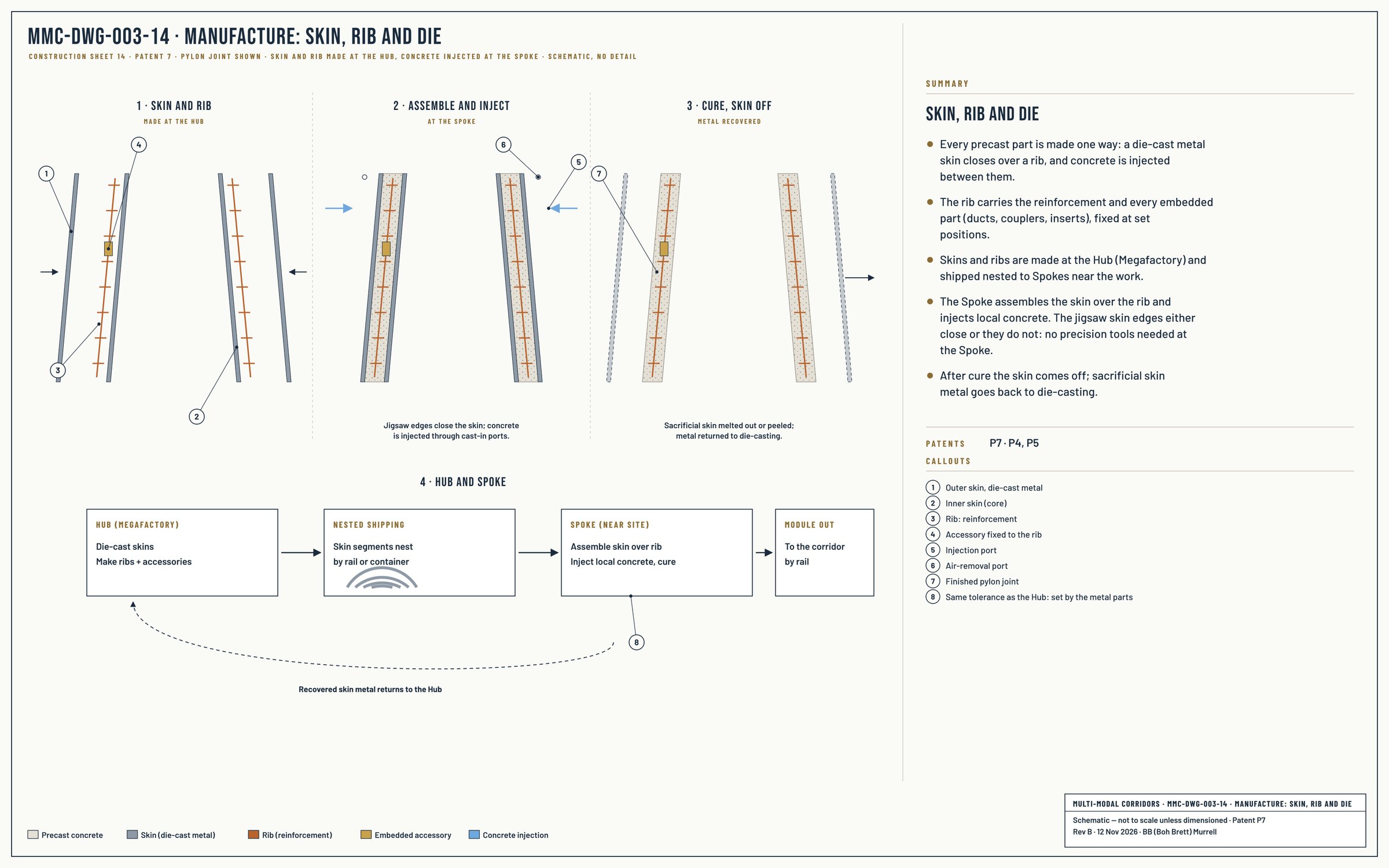
MMC-DWG-003-14 · Manufacture: Skin, Rib and Die. Skin and rib made at the Hub; assembled and injected at the Spoke; skin off after cure. Select to enlarge.

A unified assembly-line manufacturing architecture for precast concrete modules of any type, characterised by three-dimensional skin, rib, and die interconnection designed in integrated 3D CAD and produced through three-dimensional manufacturing methods — scaling from immediate deployment at existing precast facilities (conventional welded rebar) through to full design-freedom production (additively manufactured ribs in die-cast skins), with a distributed Hub-and-Spoke deployment pattern enabling precision components to be manufactured centrally and concrete injected locally at any deployment site worldwide.

The method has six integrated enablers. The first four set how a module is designed and made:

Integrated 3D CAD design as the architectural foundation. The cured module geometry is the design input, from which all production geometry — skin, rib, embedded component positions, registration features, engagement features, injection ports, air-removal ports, and master die geometry — is mathematically derived from a single source-of-truth 3D model. The master die geometry is reversed out as the negative of the skin geometry from the same model.

Skin/rib/die interconnection in three-dimensional space. The skin pieces (die-cast metal closures defining the module's external geometry), rib pieces (permanent structural elements embedded in the cured concrete, produced by any method from conventional welded rebar through to additively manufactured stainless steel), and master die geometry are designed together as a coordinated three-dimensional system. The rib performs three integrated functions through its contact with the skin: body strength (structural reinforcement), skin strength (supporting the thin die-cast skin against concrete injection pressure), and rib orientation (self-registering at engineered position through the skin's cast-in registration features).

Three-dimensional production methods for skins and ribs. Skins are die-cast at automotive cycle rates (60–120 seconds per cycle) with cast-in injection ports, air-removal ports, registration features, and engagement features as integral geometry. Ribs are produced by any metal-forming or fabrication method — conventional welded rebar (lowest capital cost), robotic fabrication, investment casting, die-casting, or additive manufacturing (best mode for complex modules). Cast-in jigsaw engagement features on skin edges provide fastener-free assembly and mechanical verification of correct fit.

Engineered strength distribution across the cured module, with heterogeneous strength characteristics tailored to the module's intended service requirement through coordinated specification of rib geometry, concrete grade, permanent skin zones, and embedded component locations.

How a module is made.

Two or more skin pieces are die-cast in metal (sacrificial, permanent, or reusable per engineering design). Where the module requires accessories — post-tensioning ducts, prestressing tendons, threaded couplers, anchor plates, lifting inserts, sensor mounts, electrical and hydraulic conduits, or any other standard precast accessory — a rib piece is produced (by conventional welded rebar fabrication, robotic fabrication, casting, or additive manufacturing as engineering choice) and the accessories are attached to the rib at precision-machined locations. The rib carries everything: structural reinforcement and all accessories. The skin pieces are assembled over the rib, with the skin's cast-in registration features locking the rib (and all attached accessories) at engineered three-dimensional position. Structural concrete is injected through engineered ports cast into the skin. After cure, the skin is removed (sacrificial skins by thermal melt-out or mechanical cut-and-peel; reusable skins by mechanical separation; permanent skins remain bonded as part of the finished module). The recovered sacrificial skin metal is returned to the die-casting station in closed loop.

Robotic line, Hub and Spoke.

Robotic factory line under unified computer control, comprising die-casting stations, rib production stations (which may be additive manufacturing, robotic fabrication, or conventional rebar stations per engineering choice), robotic assembly and joining, concrete injection, cure with parallel positions, skin separation, and closed-loop recovery of sacrificial skin metal.

Distributed Hub-and-Spoke manufacturing as a deployment architecture. The geometric precision elements — die-cast skin segments and rib pieces — are produced at a Primary Production Hub (Megafactory) and shipped in nested high-density form to Secondary Local Assembly Facilities (Spokes) proximate to deployment sites. Concrete is injected at the Spoke using local water, aggregate, and cement. The skin/rib/die interconnection architecture ensures that the Spoke-assembled module maintains the same engineered tolerance as a Hub-assembled module, with no precision instrumentation required at the Spoke — the cast-in jigsaw geometry of the skin segments either engages or it does not.

For distributed Hub-and-Spoke deployment, skin pieces are designed in the integrated 3D CAD model as engineered nestable segments (for example, four to eight curved sub-panels for a 4-metre foundation ring). The segments nest concentrically for shipping container transport — multiple modules' worth of skin and rib components per container — and mate along their cast-in jigsaw edges during robotic assembly at the Spoke. The jigsaw engagement geometry provides both fastener-free mechanical closure and mechanical verification that the assembled skin conforms to the CAD source-of-truth. A module injected and cured at a remote Spoke maintains the same sub-millimetre tolerance as one produced at the Megafactory, because the tolerance is encoded in the Hub-produced metal components, not in the Spoke's operations.

Pylon segments are precast at Megafactory production lines using the Patent 7 skin, rib and die method. The same factory produces segments for transmission towers, single-leg viaducts, and full dual-leg multi-deck corridors — varying only the diameter and topside fitting. Cap beams, longitudinal girders, and deck elements are produced on parallel lines. Tubular tension columns are manufactured in standard sections to oilfield tubular standards. Drilling rigs are manufactured at a dedicated facility, configured for MMC caisson geometry. All components leave the factory ready for deployment. Quality control occurs at the factory; nothing is inspected or adjusted at site.

Production rates, plant layout and costs: Megafactory Specification · Megafactory Economics · Caisson Megafactory Production

What conventional precast cannot do.

Conventional precast concrete production uses reusable formwork assembled on site, with separately fabricated welded steel reinforcement (rebar cages, mats, embedded plates) placed inside the formwork before concrete is poured. The formwork is stripped after cure, cleaned, and reassembled for the next pour. This architecture — essentially unchanged for over a century — has four fundamental limitations that prevent it from serving industrial-scale infrastructure production.

Cycle time is dominated by formwork stripping, cleaning, and reassembly: typically one cycle per mould per day for elements of significant size. Dimensional tolerance on embedded components (lifting inserts, post-tensioning ducts, threaded sockets, alignment dowels) is limited by wire-tie and steel-chair placement methods that cannot achieve production-line precision. Complex external geometry — interlinking joint surfaces, gasket grooves, cast-in rail fixings, integrated service channels — either cannot be produced at all in conventional reusable formwork or requires expensive multi-piece formwork with retractable inserts. And the architecture cannot be separated into a high-precision production stage and a local concrete-injection stage: the entire module must be poured and cured at a single location, requiring heavy finished concrete modules to be transported to the deployment site.

Patent coverage: P7 Assembly-Line Manufacture of Precast Concrete Modules (AU 2026904403) · Patent family →

← Service Tools & EquipmentMultimodal Corridor Build steps →