Over roads, rail and rivers; along rail, road and transmission corridors. What runs underneath keeps running.
The Claim
Over what is there, along what is there.
The elevated corridor can run over existing roads, rail lines, rivers and pipelines without cutting or closing them, and along existing transport and transmission corridors, on land already set aside. What runs underneath keeps running.
Bang Na Expressway · Thailand
55 km
Elevated road built above an existing highway for its full length.1
Caulfield–Dandenong · Melbourne
No land acquired
Elevated rail built along the existing line with trains running.3
SOO Green · USA
Railway corridor
HVDC line routed mostly along an existing railway right of way.5
Evidence
An elevated road over a working highway.
The Bang Na Expressway in Bangkok is a six-lane, 55 km elevated road. It was built on top of an at-grade highway for its entire length, while the highway below was being upgraded at the same time.1 It stands above the median strip of the Bang Na–Trat road, on a single row of pillars.2
Evidence
Elevated rail along a running line.
The Caulfield to Dandenong project in Melbourne raised the rail line over nine level crossings. The new viaduct was placed in the gap between the existing tracks and the property boundary, so it was built while trains were running and without land acquisition; trains now run about 8 m above the ground.3 Most spans were placed by a straddle carrier working beside the running tracks.4
Evidence
A power line in a railway corridor.
The SOO Green HVDC link from Iowa to Illinois is routed mostly along an existing railway right of way, which reduced easement negotiation with private landowners.5
Evidence
Planned before: a multi-tier structure over a railway.
The Bangkok Elevated Road and Train System (the Hopewell project) was designed to be built above the existing main railway tracks of greater Bangkok, with levels for a toll road, long-haul and commuter trains, and frontage roads.6 About 60 km were planned, all on top of existing State Railway of Thailand lines. The project was terminated by the Thai Cabinet in 1998, before completion.7
How MMC Does It
Pylons every 25 m; the line below stays open.
Over. The deck spans the road, rail line, river or pipeline below; only the pylon bases touch the ground, one every 25 m, each on a 4 m caisson.
Along. The corridor follows an existing rail line, road reserve or transmission line, on land already set aside. The land take is the caissons: about 0.05 ha per km for MMC-VC and 0.1 ha per km for MMC-VB.
More on the same line. Along a transmission line, the MMC structure carries the power on the arms and the other MM Lines on the decks: rail, maglev, water, fuels and fibre.
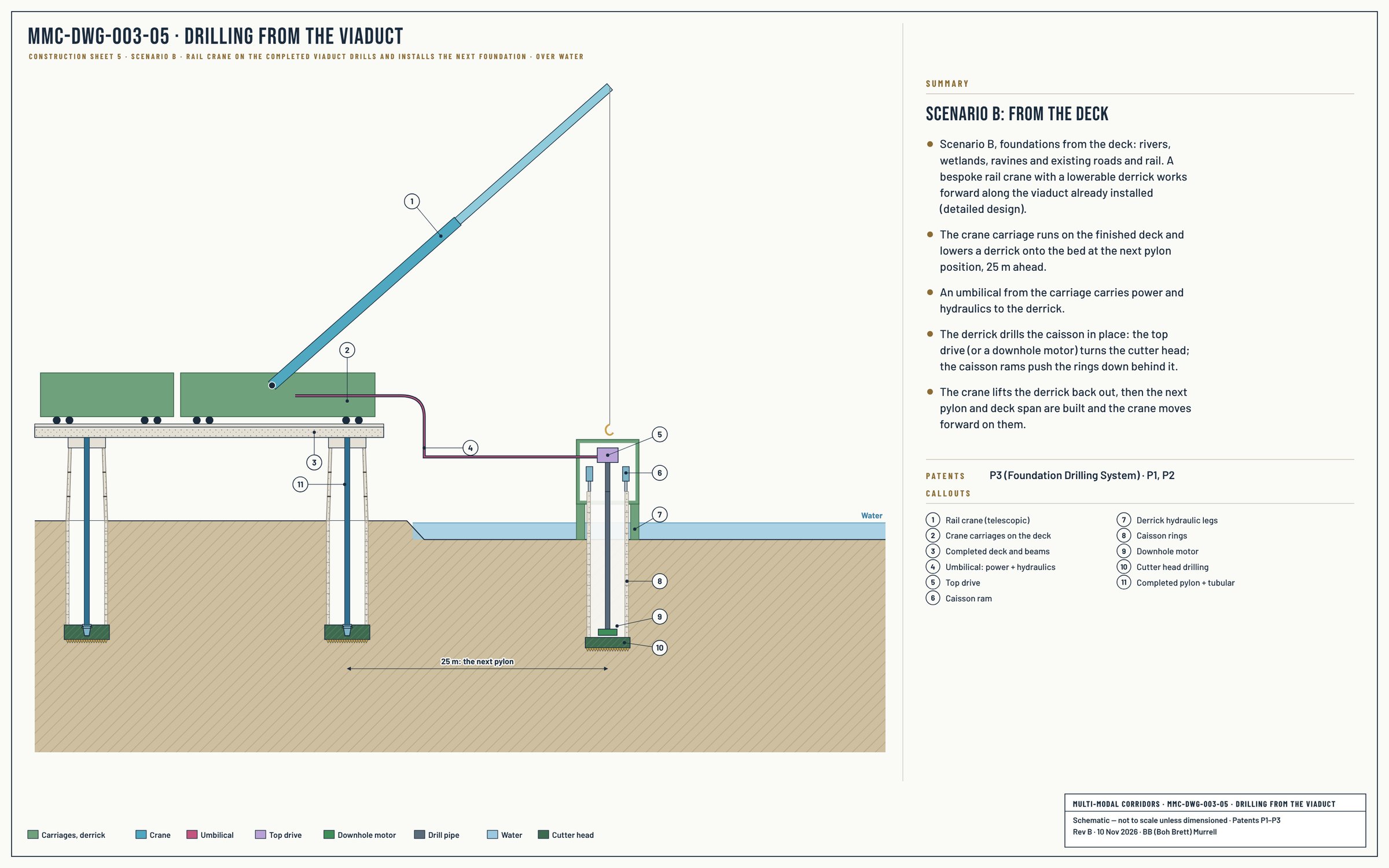
Built from above. Foundations are drilled and the topside is built from the rail and the deck, so the line underneath stays in use.
MMC-DWG-003-05 · Drilling from the Viaduct. Scenario B: foundations drilled from the deck. Select to enlarge.
Brockmann, C. and Rogenhofer, H., Bang Na Expressway, Bangkok, Thailand: World’s Longest Bridge and Largest Precasting Operation, PCI Journal, January–February 2000. www.pci.org
Bangkok Post, Call for revamp of new motorway blueprint. www.bangkokpost.com
WSP, Caulfield to Dandenong Level Crossing Removal Project. wsp.com
Victoria’s Big Build (Level Crossing Removal Project), Caulfield to Dandenong: straddle carrier fact sheet, 1 June 2017. bigbuild.vic.gov.au
World Resources Institute, Community Benefits Snapshot: SOO Green Transmission Line. www.wri.org
Bangkok Post, report on the Hopewell project (news/general/1665208). www.bangkokpost.com
Wikipedia, Bangkok Elevated Road and Train System (BERTS). en.wikipedia.org