On the MMC structure.
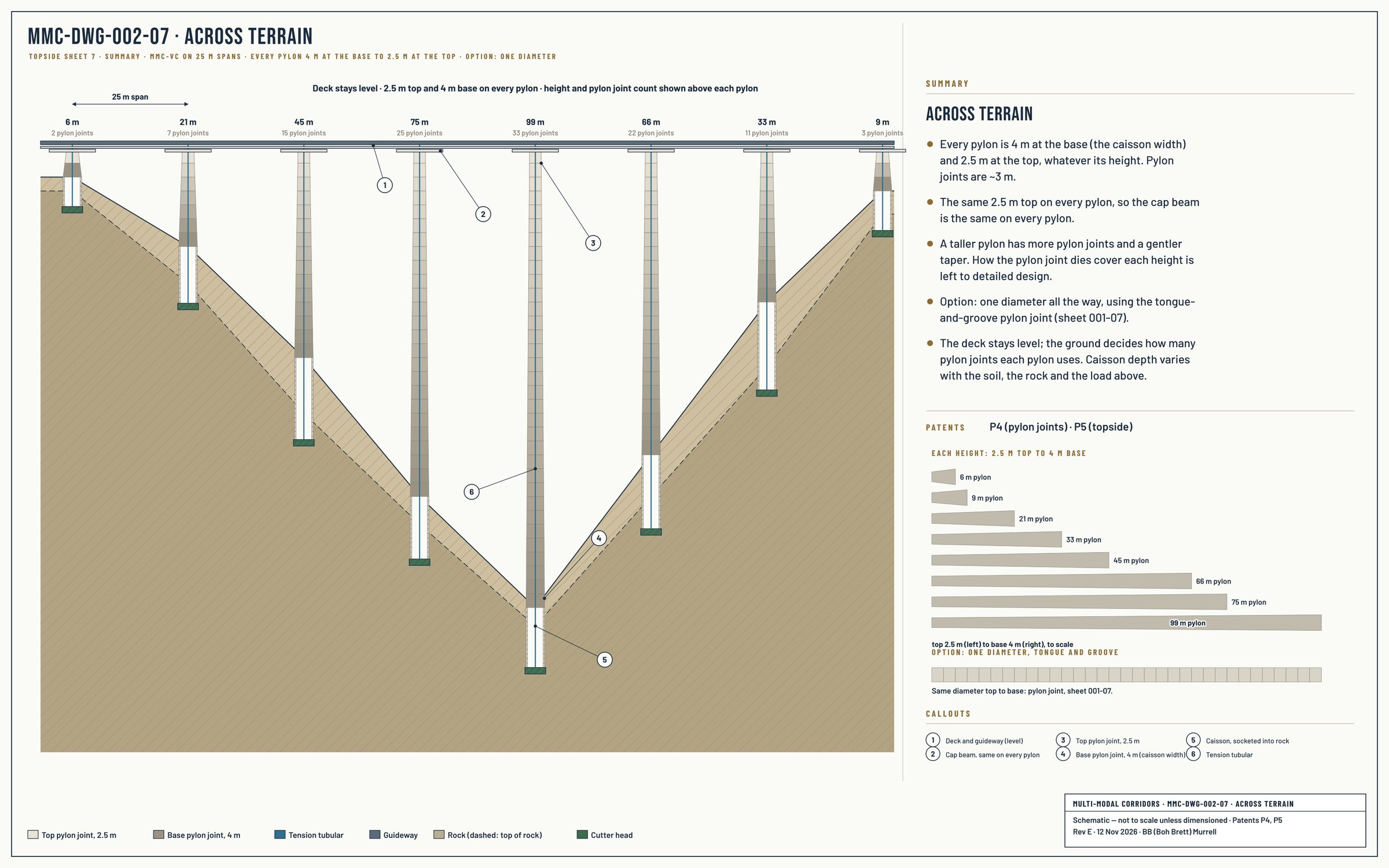
The ground take is the caisson at each pylon base, one every 25 m. The deck stays level over the ground, so there are no continuous earthworks, cuttings or embankments, and the land under the corridor stays in use.
A level deck is also a flat, steady line. Hyperloop needs one; the two ways to give it one are elevated or underground. MMC is the elevated way.
Land take
Land disturbance is concentrated at the pylon foundations: about 12.6 m² for each 4.0 m caisson, one per leg, at pylons 25 m apart on the viaducts (40 per km) and about 200 m apart on transmission towers. Between pylons the ground stays as it was: vegetation, hydrology, soil and micro-topography.
For a 2,000 km corridor (derived): the caissons occupy about 1.0 km² for MMC-VC (one leg per pylon) and about 2.0 km² for MMC-VB (two legs). For comparison, HS2 Phase One in the UK acquired about 70 km² for 225 km of new line, about 31 ha per km including depots and replacement land; at that rate 2,000 km would take about 620 km². Its 2009 estimate assumed a 120 m corridor, about 12 ha per km, or 240 km² over 2,000 km.1
Assumptions: 25 m spans; caisson ring 4.0 m outside diameter; flat ground. Counts the caisson at ground level only: excludes construction access, any fencing at pylon bases, stations and depots. The HS2 figures include depots and replacement land, so they are not like-for-like with the caisson figure; they show the order of difference.
The path under the viaduct
The space under the viaduct can carry a continuous path for cycling, walking and riding, the full length of the corridor, sheltered from sun and rain by the deck above and separated from the moving lines by height. It sits inside the corridor footprint, with no extra land.
Runoff, light and noise
- Runoff and hydrology. Native drainage stays in place; watercourses pass under the structure without diversion or culverts.
- Light and noise. Services run at deck height, about 8 to 42 m above ground, away from ground-level habitat.