The freight line is built first, then carries the components and the crews for the rest of the build.
The Claim
Rail for everything.
The freight line is built first and then supplies the rest of the build. Components are delivered by rail, crews travel by rail, and construction proceeds without new road access along the route.
Energy per tonne-km
~10× less
Rail 0.12 PJ per billion tonne-km against 1.25 PJ for road, Australia.1
Carbon
16× less
Rail against road freight, per the Australasian Railway Association.2
Accident costs
22× lower
Road accident costs per tonne-km are 22 times rail’s.2
Rail freight in Australia uses about 0.12 PJ of energy per billion tonne-kilometres, against 1.25 PJ for road: roughly ten times more efficient.1 The Australasian Railway Association reports 16 times less carbon than road freight and road accident costs 22 times higher than rail per tonne-kilometre.2
Evidence
Building from the track already laid.
Track renewal and new track are already built by the assembly-line method, with material supplied along the track under construction. Plasser & Theurer lists no need for additional access roads and construction roads among its advantages.3
HS2 sends tunnel segments from Hartlepool by freight train; one train carries up to 20 segment rings, enough for 38 m of tunnel.4
How MMC Does It
The corridor carries its own construction traffic.
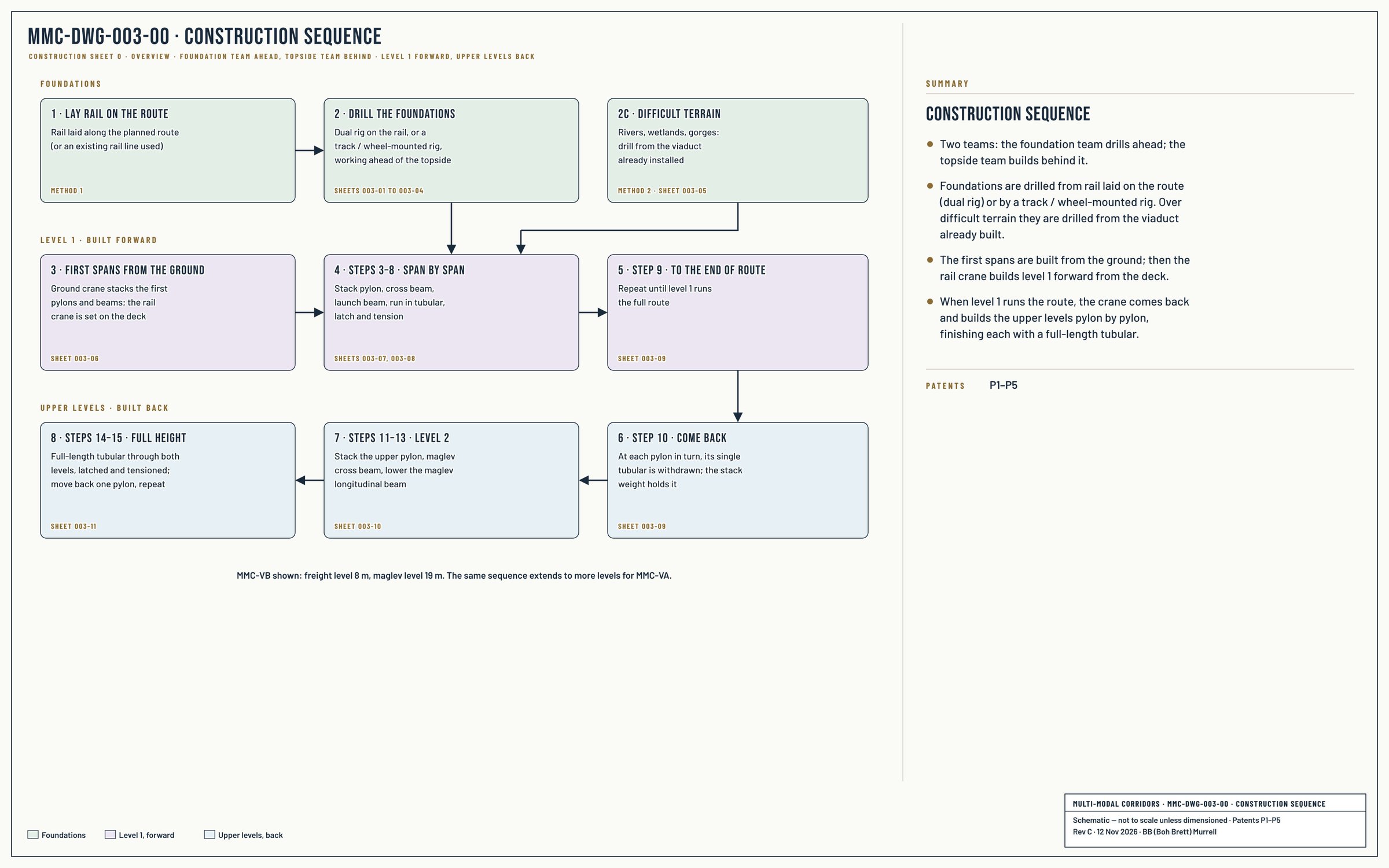
Rail is laid first; the foundation team drills from it.
Caisson rings travel on edge in transport frames on flat wagons: 2 m wide in transit.
The bespoke rail crane on the deck, rated for ~100 t, places the heaviest parts: a 25 m beam (~72 t, estimate) and cap beams up to ~65 t.
MMC-DWG-003-00 · Construction Sequence. Rail first; foundations ahead; topside behind. Select to enlarge.
Centre for Future Work (Toner and Stanford), Rail freight could save Australia billions in fuel costs and cut energy vulnerability, 2026. futurework.org.au
Australasian Railway Association, Value of rail freight, September 2025. ara.net.au