Precast caisson, no pile driving, no cure wait; the tension that holds the structure together can be inspected, re-tensioned and replaced for the life of the structure.
Precast caisson
Made in the factory, stacked as it drills.
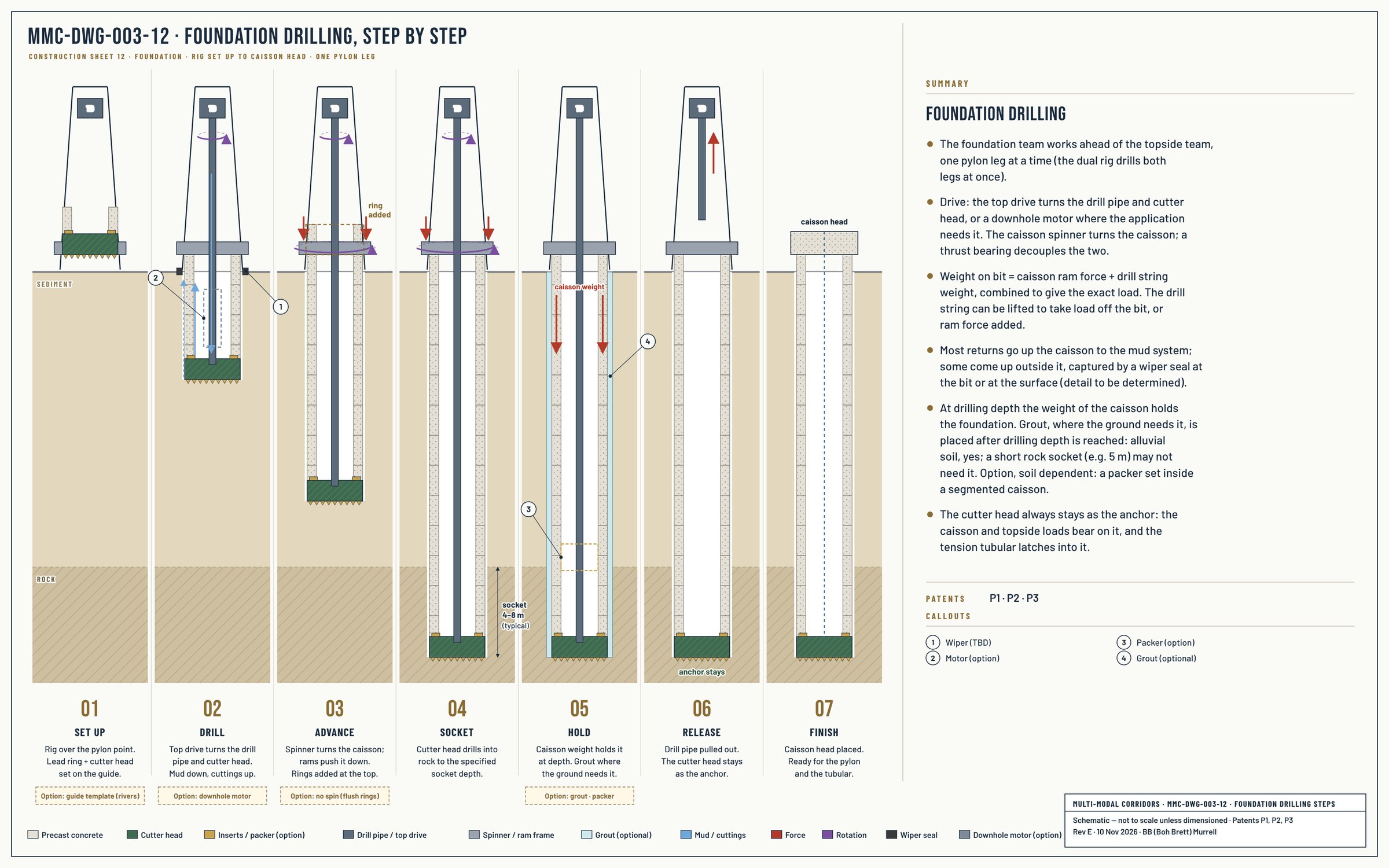
The caisson is not poured in the ground. Precast caisson rings, made in the factory to one standard, are added at the surface as the cutter head drills down; the stack follows the bore. At drilling depth the weight of the caisson holds the foundation in place, and the cutter head stays as the anchor.
Set up. The rig is set over the pylon point; the lead caisson ring and cutter head are set on the guide.
Drill. The top drive (or a downhole motor) turns the cutter head; mud carries the cuttings up the caisson.
Advance. Rings are added at the top; the caisson rams push the stack down behind the cutter head.
Socket. The cutter head drills into rock to the specified depth.
Hold. The weight of the caisson holds the foundation at depth.
Release and finish. The drill pipe is withdrawn; the caisson head is placed, ready for the pylon.
MMC-DWG-003-12 · Foundation Drilling, Step by Step. Seven steps, with the options by application. Select to enlarge.
No piles are driven. The caisson is drilled in and follows the cutter head down, so there is no hammering of piles into the ground at each foundation.
Each foundation is the same operation: the same rig, the same rings, the same steps, repeated pylon after pylon. The crews know the next step before they reach the site.
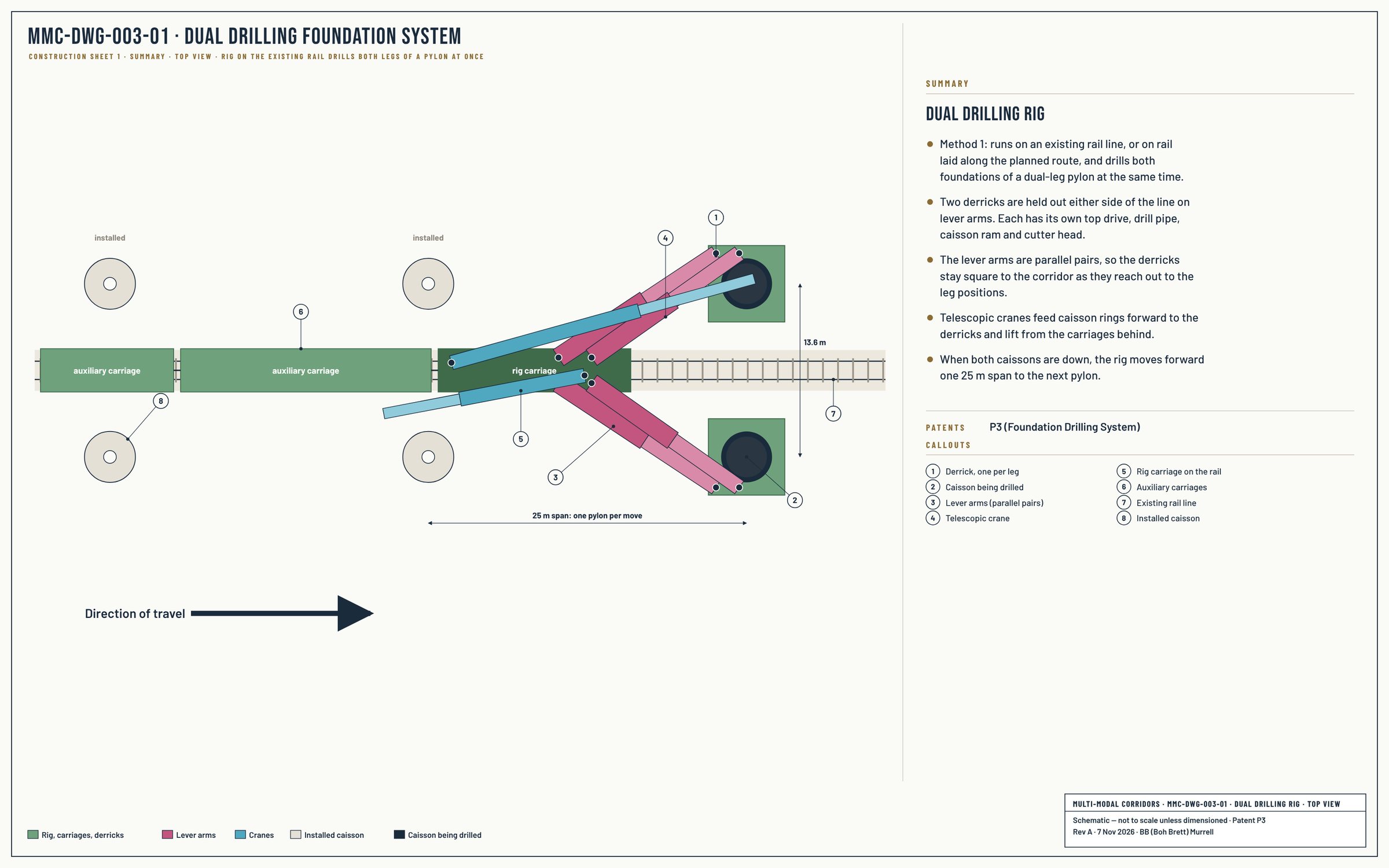
MMC-DWG-003-01 · Dual Drilling Rig. The rig on rail drills both caissons of a pylon at once. Select to enlarge.
No cure wait
The topside does not wait on the ground.
The topside does not wait on the ground. Grout is optional: it is placed only where the ground needs it (in alluvial soil, yes; a short rock socket may not need it), and then much less is used. The forward crews place it after drilling depth is reached, ahead of the topside team, off the topside’s path.
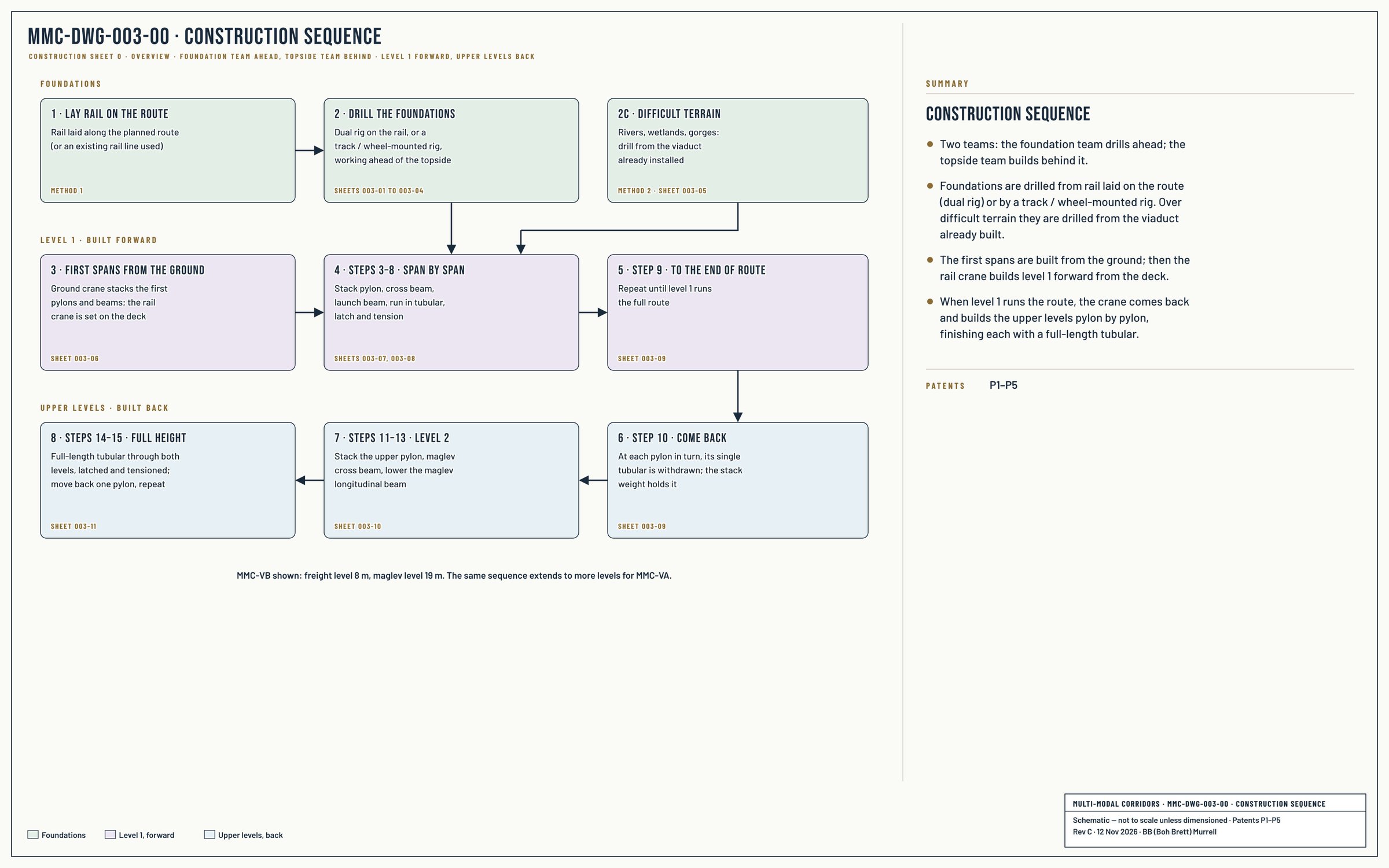
Foundation team: drills, places the caisson head, grouts where needed.
Topside team: follows behind, stacking the pylon and setting the beams on finished foundations.
MMC-DWG-003-00 · Construction Sequence. Foundation team ahead, topside team behind. Select to enlarge.
Inspectable tension
Reached for its whole life.
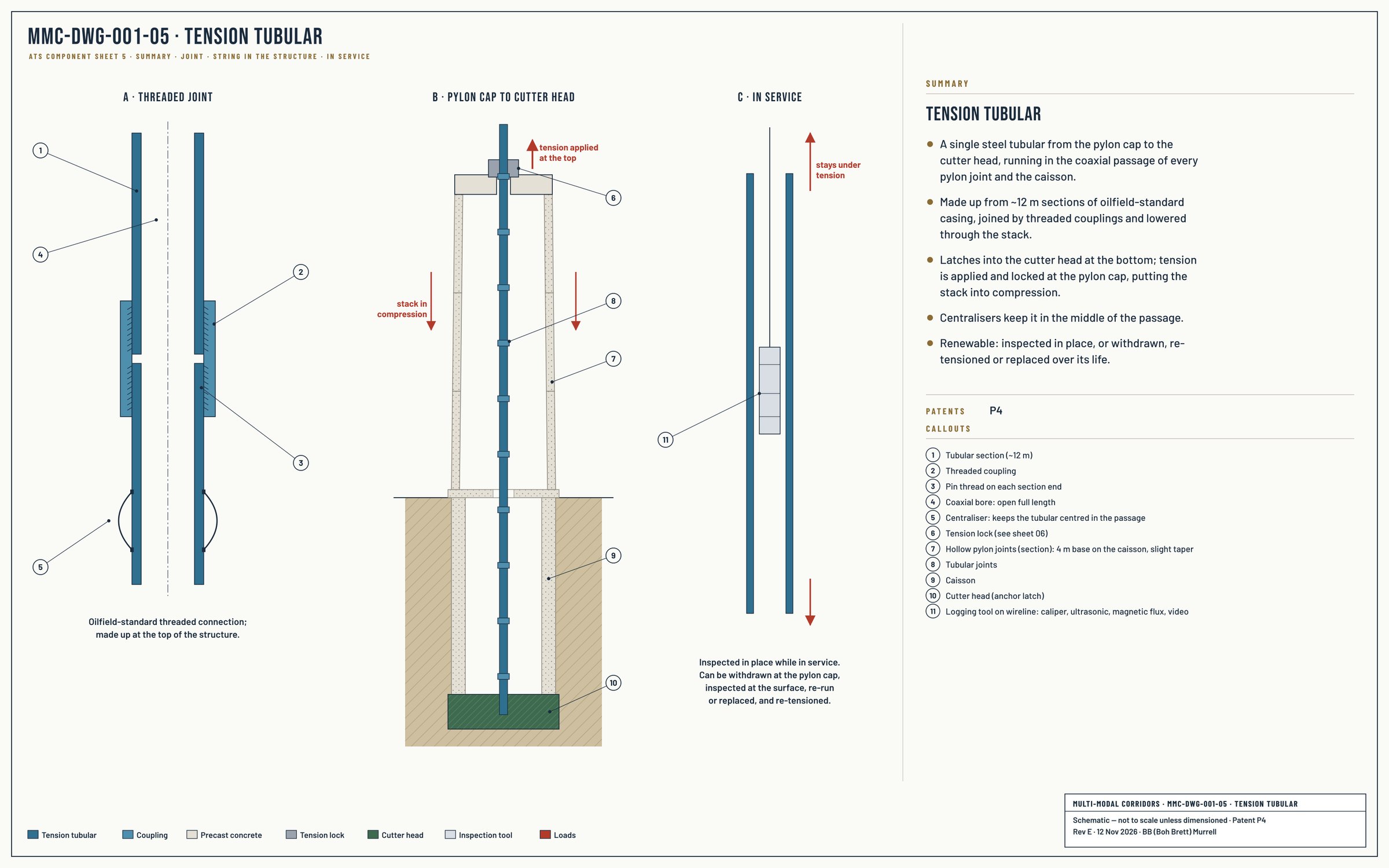
The tension tubular runs from the cutter head anchor to the top of the structure in an open passage through the caisson and every pylon segment. Because the passage is open, the tubular can be reached for its whole life.
Inspected in place: logging tools on wireline (caliper, ultrasonic, magnetic flux, video) run down the tubular while it stays in service.
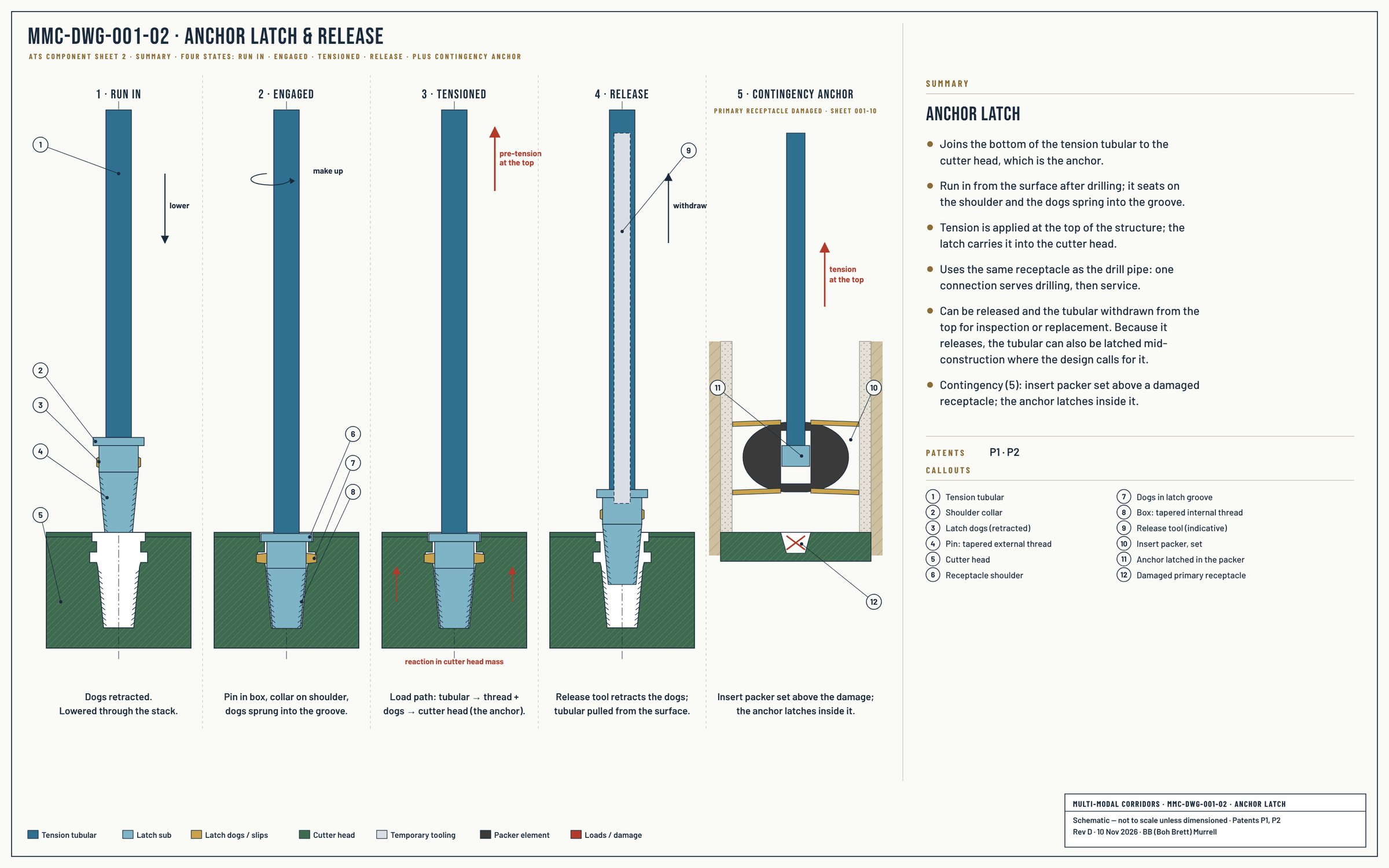
Withdrawn and replaced: the tubular can be released at the anchor latch, pulled at the top, inspected at the surface, re-run or replaced, and re-tensioned.
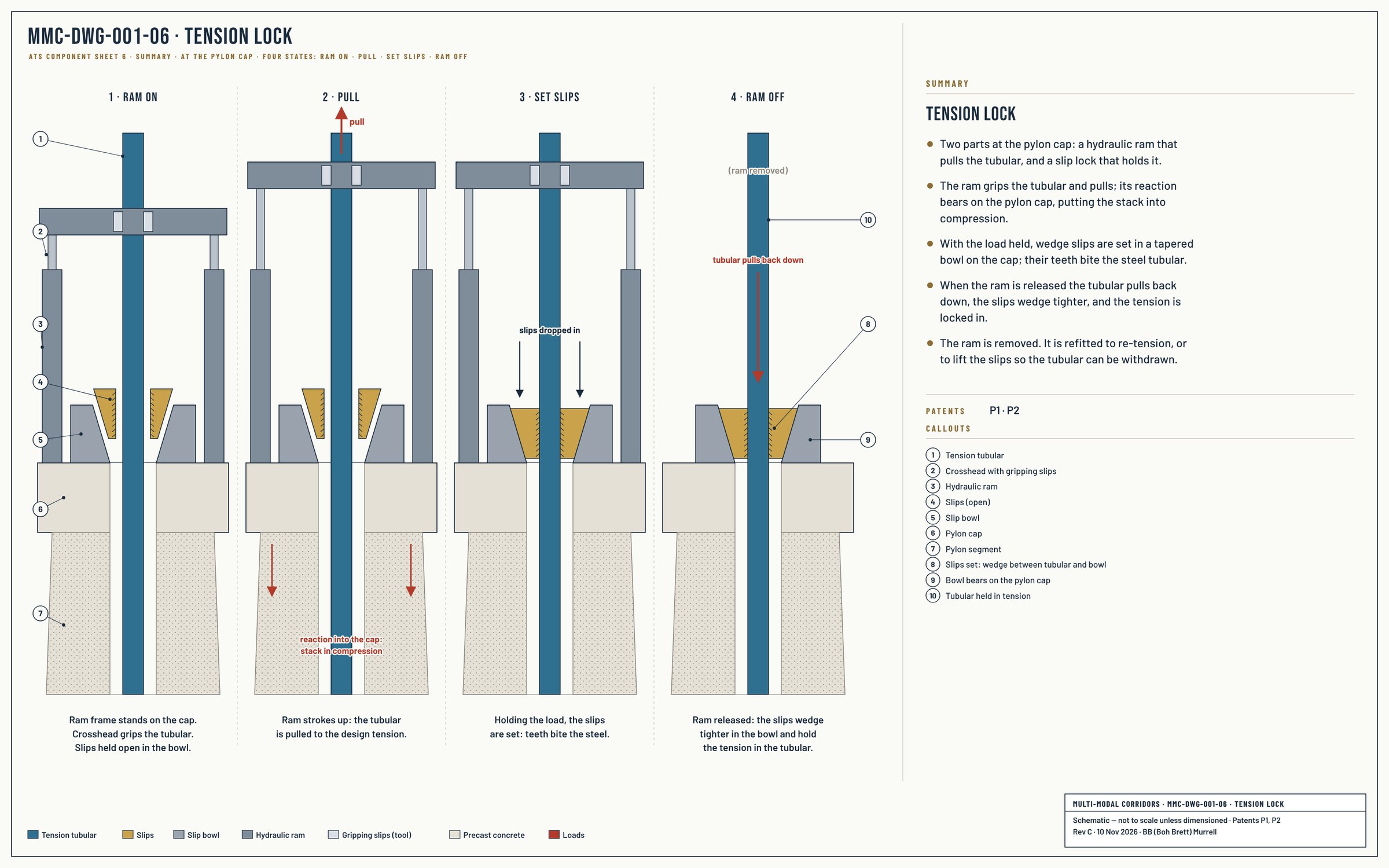
Re-tensioned: the tension lock at the top can be released and reset.
MMC-DWG-001-05 · Tension Tubular. Threaded joint, string in the structure, inspection in service. Select to enlarge.MMC-DWG-001-06 · Tension Lock. Ram, slips and bowl: the tension is locked in, and can be released. Select to enlarge.
Replaceable joints
Threaded, made up at the top.
The tubular is made up from ~12 m sections of oilfield-standard casing with threaded connections. The sections are screwed together at the top of the structure and run in, as on a drill rig; each joint can be broken out and replaced when the string is pulled.
This is the long-term problem the design addresses: steel reinforcement cast into concrete cannot be inspected or replaced. In the MMC structure the main tension element is outside the concrete, in a passage that stays open.
MMC-DWG-001-02 · Anchor Latch and Release. The tubular latches into the cutter head and can be released. Select to enlarge.