Advantage 13

Cheap transport and services for all.

Poverty follows the people that transport, power and water do not reach. MMC proposes one corridor that brings low-cost travel, freight, electricity and water to every town along it, so people can reach markets, work, schools and health care. Linked grids bring solar power from the deserts along the corridors.

What MMC proposes.

Poverty follows the people that transport, power and water do not reach. MMC proposes one corridor that brings low-cost travel, freight, electricity and water to every town along it, so people can reach markets, work, schools and health care. Linked grids bring solar power from the deserts along the corridors.

Without electricity
655 m

People without electricity in 2024.1 84% of people without electricity live in rural areas (2023).2

Without safe water
2.1 bn

People without safely managed drinking water in 2024: 1 in 4 people worldwide.3

Without a road
~1 bn

Rural people living more than 2 km from an all-season road (World Bank Rural Access Index, 2006 estimate).4
Solar power from the deserts, along the corridors.

Basis and assumptions.

The corridor carries the services; reaching homes away from the corridor needs local networks built from it. That MMC lowers the cost of transport and services for the people it reaches is the MMC proposal. The road figure is an old (2006) global estimate.

On the MMC structure.

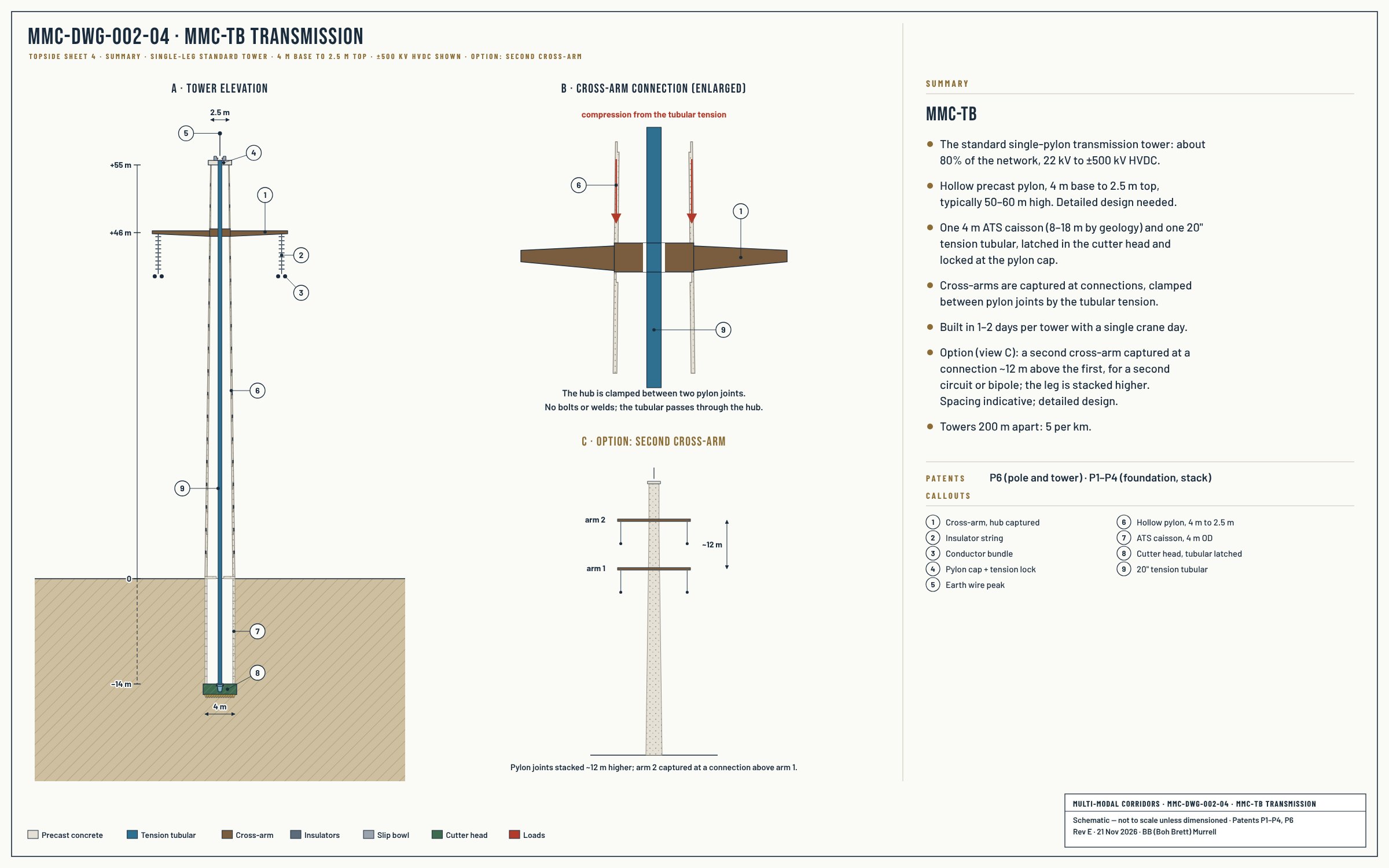
The corridor carries the power out: solar from desert regions on HVDC along the same structure that carries freight, passengers, water and fibre.

MMC-DWG-002-04 MMC-TB Transmission
MMC-DWG-002-04 · MMC-TB Transmission. The standard transmission tower. Select to enlarge.

HVDC →   Water →

References.

  1. SEforALL, Tracking SDG7: The Energy Progress Report 2026 (IEA, IRENA, UNSD, World Bank, WHO). www.seforall.org
  2. World Bank, Tracking SDG 7 – The Energy Progress Report 2025, highlights, 20 June 2025. www.worldbank.org
  3. WHO/UNICEF JMP, Progress on household drinking water, sanitation and hygiene 2000–2024, August 2025. data.unicef.org
  4. World Bank, Measuring Rural Access: Update 2017/18, 2019 (citing the 2006 Rural Access Index). documents1.worldbank.org
  5. World Bank (ESMAP), Solar Photovoltaic Power Potential by Country, 23 July 2020. www.worldbank.org
  6. Solargis, Seasonality and socioeconomics: assessing global PV potential for the World Bank. solargis.com
  7. Energy-Storage.news, Australian government approves renewables link to Singapore with up to 42GWh energy storage, 2024. www.energy-storage.news
← 12 · One global grid14 · Calculated foundations →