Ten services on one alignment, one corridor, one set of foundations: each service avoids the cost of its own corridor.
The Claim
One structure instead of many corridors.
Ten services share one alignment, one land corridor, one set of foundations and one structure: maglev, freight rail, service rail, road, HVDC, water, gas and liquid fuels, hydrogen, fibre and hyperloop. Built separately, each needs its own corridor.
Fibre · roadway excavation
90%
Share of the cost of deploying broadband where the work needs significant excavation of the roadway (US FHWA).1
HVDC on a rail corridor
350 miles · 2.1 GW
SOO Green: underground HVDC built mostly within a railway right of way.3
Eastern Australia · new transmission
~6,000 km
Needed by 2050 in AEMO’s 2026 plan, A$16 bn up-front (present value).5
Evidence
Laying services together costs less.
Most of the cost of a buried service is the digging, not the cable. The US Federal Highway Administration states that ninety percent of the cost of deploying broadband is when the work requires significant excavation of the roadway.1
The US Government Accountability Office reports that Utah’s Department of Transportation estimated savings of roughly 15.5% per mile when conduit and fibre were installed during a road project (rural projects), and that one state DOT and a San Francisco engineering assessment estimated savings of 25–33%, greatest in densely populated areas.2
Evidence
Shared corridors are easier to build.
The SOO Green HVDC Link is a 350-mile, 2,100 MW, 525 kV underground line from Iowa to Illinois, built mostly along an existing railway right of way. Because it sits in the railway corridor, it needed very little easement negotiation with private landowners.3 All but about 18 miles of the route is on the railway’s right of way.4
Evidence
Transmission is needed anyway.
AEMO’s 2026 Integrated System Plan needs about 6,000 km of new transmission in the eastern states by 2050, at an up-front capital cost of A$16 bn (present value).5 On MMC that transmission runs on the rail structure.
How MMC Does It
Each service has a set place on the structure.
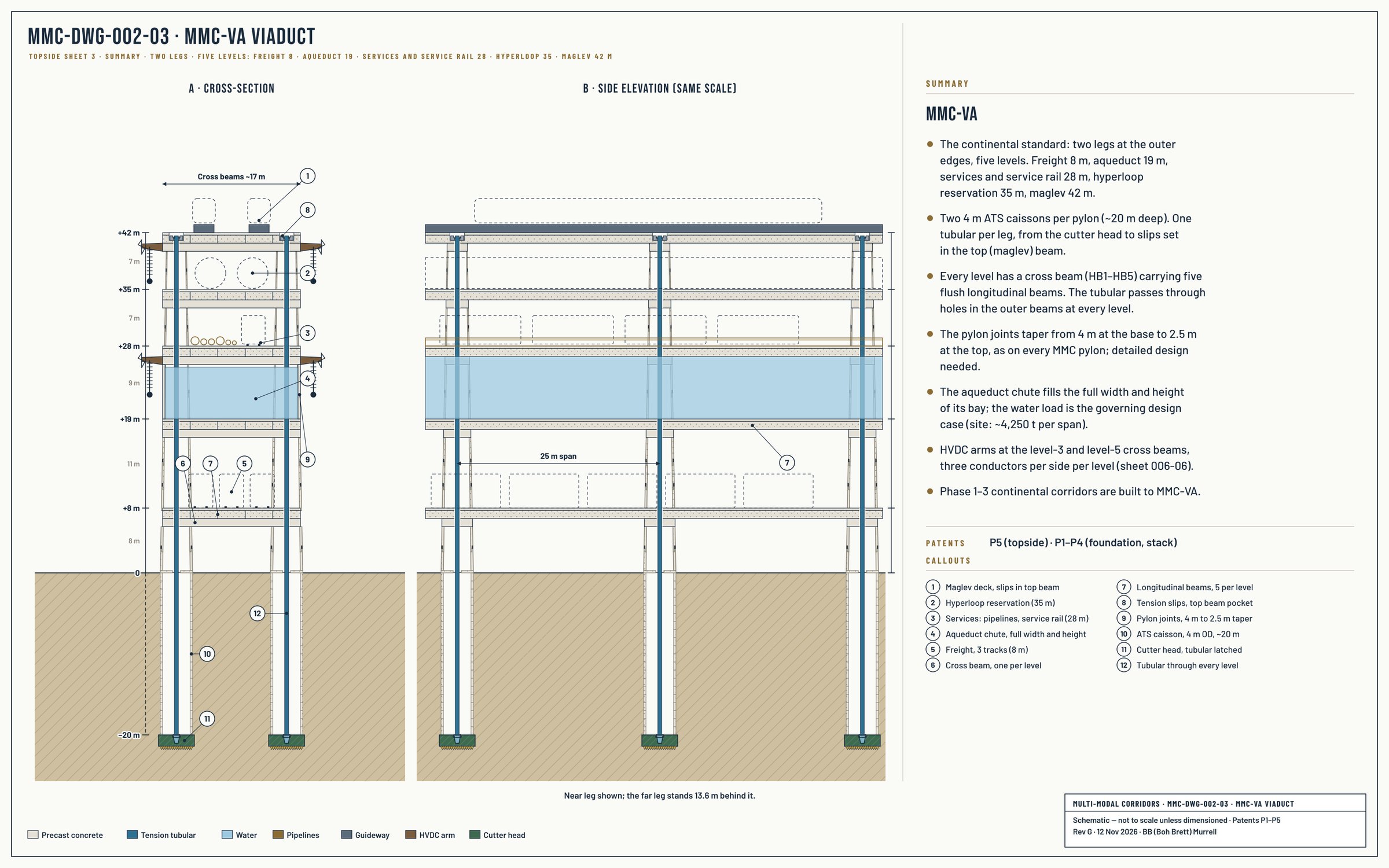
The foundations, the pylons, the land and the access are built once. Each service has a standard position: freight below, maglev above, HVDC on the arms, pipes and fibre in the structure.
MMC-DWG-002-03 · MMC-VA Viaduct. Five levels on one structure: freight, aqueduct, services, hyperloop reservation and maglev. Select to enlarge.
US Federal Highway Administration, Executive Order: Accelerating Broadband Infrastructure Deployment, Background Paper and Work Plan Strategy, December 2012. www.fhwa.dot.gov
US Government Accountability Office, Broadband Conduit Deployment: Planning and Flexibility Are Key to Effectively Deploying Broadband Conduit through Federal Highway Projects, GAO-12-687R, 27 June 2012. www.gao.gov
World Resources Institute, Community Benefits Snapshot: SOO Green Transmission Line. www.wri.org
Iowa Utilities Board, IUB approves SOO Green underground electric transmission line project, 13 September 2023. iuc.iowa.gov
AEMO, 2026 Integrated System Plan, 25 June 2026. www.aemo.com.au