Humanity needs a shared vision that directs nations away from war with each other. This proposal has two parts. Part A is the Multi-Modal Corridor build on Earth. Part B is one united effort to explore the solar system and to build ships, engines, bases and industry there. It proposes a staged shift of military workforce and funding to that united space effort.
Military spending divided by civil space spending.
Military production consumes scarce metals, fuel and the working lives of engineers and tradespeople. The product is equipment built to destroy other equipment and to kill people.
02Single use
A missile flies once.
A ballistic missile flies once. The interceptor sent to stop it also flies once. Both are destroyed, with the engines, guidance electronics, magnets and metals they contain.
In the 2026 Iran war the United States expended about 2,050 missile-defence interceptors.3 Replacing them costs US$13.1 billion,4 about one fifth of what all nations spend on civil space in a year.
A space launcher is the same machine with a different payload: the first rockets to reach orbit were ballistic missiles. A reusable launcher lands and flies again.
03Scarce metals
Destroyed on use, and not recovered.
Modern weapons depend on a short list of scarce metals. Defence takes about 10 to 12 per cent of the world’s tungsten and about 9 per cent of its titanium sponge.5 Aerospace and defence is the largest buyer of samarium, the rare earth in heat-resistant magnets.6 Rare earth magnets are in drone motors, missile actuators and radar. The metal in a munition is destroyed on use and is not recovered.
04An end to nuclear weapons
A rocket built never to fly.
On 19 November 2026, at a meeting in Shenzhen with the presidents of the United States and Russia, China’s President Xi Jinping called for nuclear weapons to be completely banned and eliminated.12 That is part of this goal.
A nuclear missile is a rocket built never to fly. The motors, the guidance systems and the engineers who build them are the same ones a space programme needs. Space gives that industry and those people a new task, so that a nation can retire the weapon without retiring the workforce.
The precedent exists: the 1967 Outer Space Treaty bars nuclear weapons from orbit and from the Moon.
05A shared direction
Two things to build together.
This proposal gives people two things to build together. On Earth: the Multi-Modal Corridors. In space: ships, engines, bases and industry across the solar system, as one effort.
The transition. Military spending does not stop overnight. Nations begin a staged transfer, and over time most of the funds, the scarce metals and the people move to space exploration. The trades are the same. The purpose changes.
06Shared technology
For humanity and for all nations.
The goal is technology shared for humanity and for all nations. One effort means shared work: shared designs, shared standards, shared data and shared AI. Each nation builds to the same specification, and each nation’s hardware connects to the others’.
Technology built for space returns to Earth. NASA has documented more than 2,000 spinoff technologies.19 The image sensor in a phone camera was developed for spacecraft. Memory foam, water purification systems and firefighting equipment came from the same source.20 A larger space programme produces more of this, and a shared programme gives it to every nation that takes part.
Defence works the other way. Under the United States Invention Secrecy Act, a patent can be withheld and the inventor barred from disclosing the invention. At the end of 2024, 6,471 such orders were in force. One radar patent filed in 1977 was granted in 2014.21 The public GPS signal was deliberately degraded until May 2000.22 GPS, the internet and radar all began as defence projects and did reach the public; the cost is the delay and the restriction. NASA is required by its founding Act to disseminate its results as widely as practicable.23
07Rivals already work together
In space, cooperation has outlasted disputes.
On 17 July 1975, during the Cold War, an American Apollo spacecraft docked with a Soviet Soyuz and the two crews shook hands in orbit.24 Since November 2000, Americans and Russians have lived together on the International Space Station.13
In July 2022, despite tensions between the two countries, the two space agencies signed an agreement to fly on each other’s spacecraft. In July 2026 Russia agreed to support the station through 2030 and to continue those flights.25 Space is one of the last fields where the two nations kept working together.
08The engineering
What has to be designed and built.
Twelve workstreams. Each is a design task, and each uses trades that military industry already has.
Workstream
What is engineered
1. Launch
Reusable heavy lift from Earth to orbit, with shared pad and payload standards
2. Ships
Crew and cargo vessels built in orbit for travel between bodies
3. Landers and tugs
Vehicles for surface to orbit at the Moon, Mars and the asteroids
4. Engines
Chemical, nuclear thermal, nuclear electric and solar electric propulsion
5. Power
Solar arrays, fission reactors for bases and ships, energy storage
6. Bases
Structure, radiation shielding, pressure vessels, construction from local material
7. Life support
Closed-loop air, water and food production
8. Resources
Water ice, oxygen, metals and propellant produced off Earth
9. Yards and depots
Orbital shipyards, fuel depots and repair docks
10. Robotics and AI
Autonomous construction, mining and maintenance ahead of crews
11. Communications and navigation
A solar system relay network and positioning
12. Standards
Common docking, power, data and fuel interfaces, so that every nation’s hardware connects
09Bases
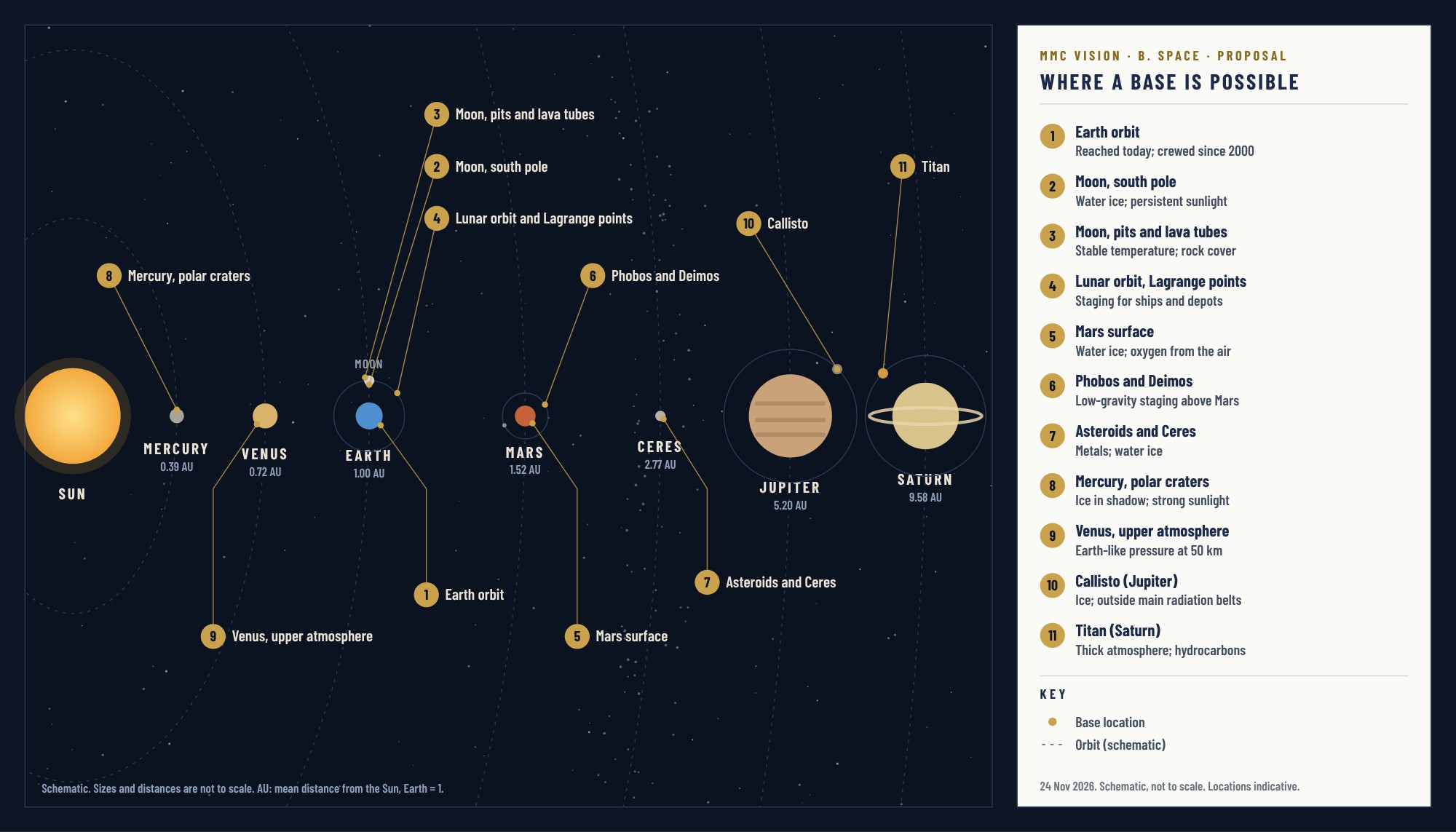
Where a base is possible.
Where a base is possible: eleven locations. Schematic; sizes and distances are not to scale.
Location
What makes it possible
Main constraint
Earth orbit
Reached today; crews have lived in orbit continuously since November 200013
Resupply from Earth
Moon, south pole
Water ice in permanently shadowed craters; high ground with persistent sunlight. NASA announced a US$20 billion Moon base here in March 20267
Dust, radiation, extreme cold in shadow
Moon, pits and lava tubes
Shaded pit floors stay near 17 °C; rock cover gives some protection from radiation and micrometeorites14
Access and survey
Lunar orbit and Lagrange points
Staging positions for ships and depots; NASA’s Gateway station was designed for a halo orbit around the Moon as a staging point, and was paused in March 2026 in favour of a surface base15
No local material
Mars surface
Underground water ice; a carbon dioxide atmosphere that yields oxygen8
Thin air, radiation, a transit of months
Phobos and Deimos
Low-gravity staging above Mars; Japan’s MMX mission, launched October 2026, is assessing Phobos as a base for crewed Mars exploration16
Composition and origin not yet confirmed
Asteroids and Ceres
Asteroids thought to be metal-rich, such as Psyche; permanently shadowed craters on Ceres cold enough to trap water ice17
Very low gravity, distance
Mercury, polar craters
Water ice in permanent shadow; strong sunlight nearby9
Heat, high energy cost to reach
Venus, upper atmosphere
About one Earth atmosphere of pressure at 50 km altitude; studied by NASA as an airship concept18
Floating habitat, sulfuric acid clouds, about 75 °C
Callisto (Jupiter)
Ice; outside Jupiter’s main radiation belts. Chosen by a NASA study as the outer-planet destination10
Distance, weak sunlight, cosmic rays
Titan (Saturn)
An atmosphere about 1.5 times Earth’s surface pressure that absorbs radiation; hydrocarbons11
Extreme cold, distance
This is a proposal for discussion. Detailed design and a large engineering effort are required.
10Assumptions and sources
What the page rests on.
A1. Ratio. US$2,887 billion divided by US$63.7 billion. Defence space spending (US$73.5 billion) is excluded from the civil figure.
A2. Interceptors. United States figures only. One fifth is US$13.1 billion divided by US$63.7 billion.
A3. Metals. Shares are from commercial market reports. No share is stated for rare earth magnets as a whole, where defence is a small part of world demand by tonnage.
A4. Bases. Each row is referenced. Lagrange points are general knowledge. The Venus and Callisto entries rest on NASA concept studies, not on planned missions.
A5. Technology. The secrecy and GPS figures are United States law and data. The statement that a larger programme produces more spinoff technology is an inference. The defence origin of the internet and radar is general knowledge.
A6. Scope. The page names no governing body, no share of spending, no dates and no programme cost.