One global build, through record debt and the AI transition: work in every nation, and infrastructure that grows output.
The Claim
One global build, through debt and the AI transition.
Record debt and the AI transition arrive in the same decade. A global build of corridors, and the new cities along them, puts people to work in every nation that joins and leaves assets that earn for a century.
Global debt rose by more than US$10 trillion in the first half of 2026 to a record above US$365 trillion, with China and the United States accounting for most of the increase.1 Advanced economies paid more than US$3.3 trillion in interest on internationally traded government bonds over the past year: more than estimated world spending on defence (US$3.1 trillion), AI (US$2.6 trillion) or clean energy (US$2.3 trillion).2
Evidence
AI and jobs.
The IMF estimates that almost 40 per cent of global employment is exposed to AI: about 60 per cent in advanced economies, 40 per cent in emerging markets and 26 per cent in low-income countries. For about half of the exposed jobs in advanced economies, AI may carry out key tasks now done by people, lowering labour demand, wages and hiring; in the most extreme cases some jobs may disappear.3
Evidence
Infrastructure raises output.
The IMF found that increased public infrastructure investment raises output in the short term by boosting demand and in the long term by raising productive capacity. Where it is done efficiently, the rise in GDP offsets the rise in debt, so the public debt-to-GDP ratio does not rise.4
The same study sets two conditions: the gains are largest when an economy has spare capacity and when investment is efficient. Where investment is inefficient, the gains are smaller and debt-to-GDP may rise.4 A fixed catalogue of standard parts, built the same way in every nation, is MMC’s answer to the efficiency condition.
Evidence
The New Deal: building through a depression.
The Works Progress Administration, created in 1935 under Roosevelt’s New Deal, put about 8.5 million people to work over eight years, when more than 11 million were unemployed in 1934, at a federal cost of about US$11 billion. Its projects produced more than 650,000 miles (1,046,000 km) of roads, 125,000 public buildings, 75,000 bridges, 8,000 parks and 800 airports.5
A Build for Every Nation
One standard, a uniter of nations.
The build runs to one standard, so every nation that joins builds the same corridor, and each corridor joins the next. The work, the factories and the jobs are in each nation; the standard is shared.
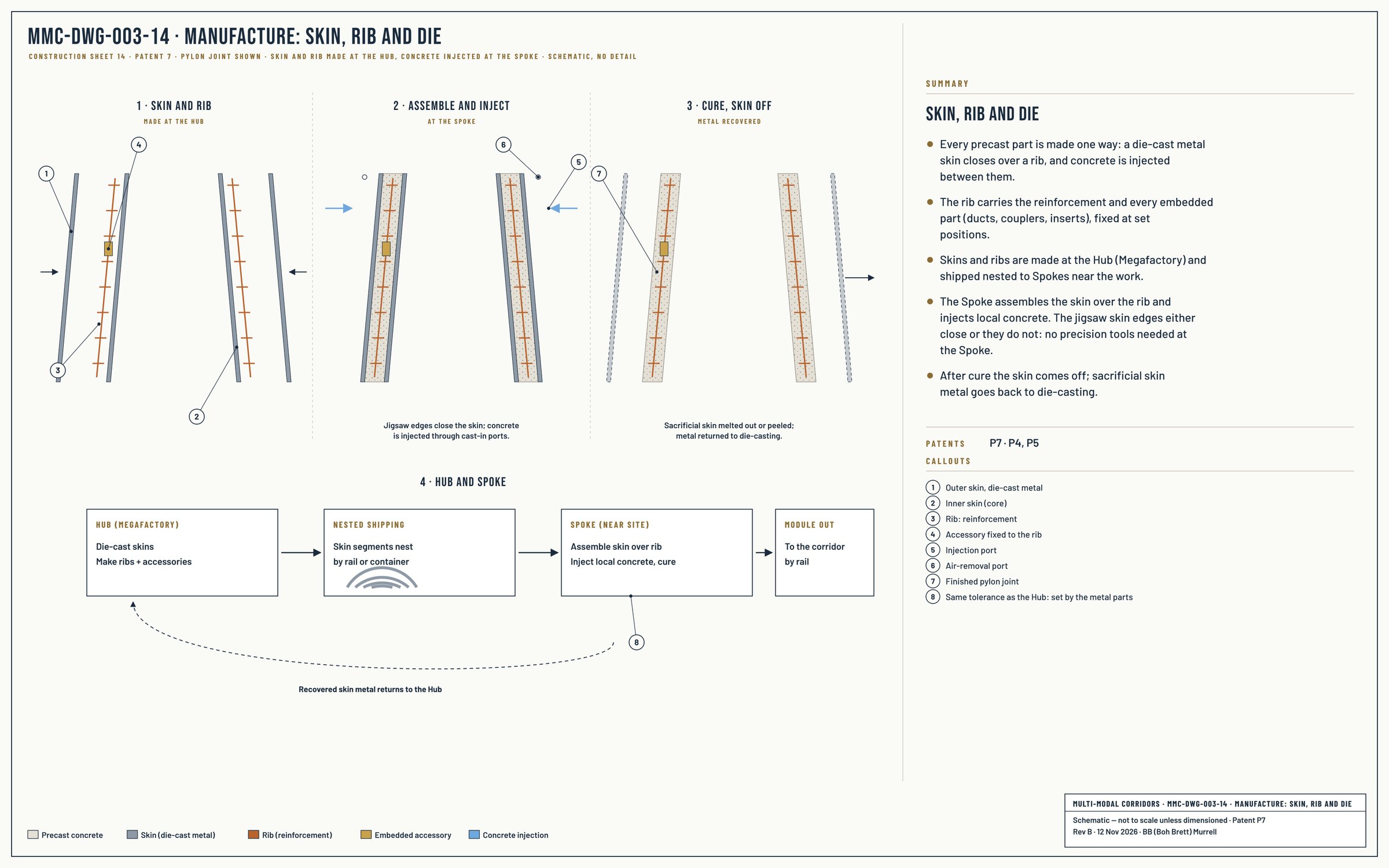
A fixed catalogue of standard parts, built the same way in every nation, is MMC’s answer to the efficiency condition. The work, the factories and the jobs are in each nation.
MMC-DWG-003-14 · Manufacture: Skin, Rib and Die. Hub and Spoke: factories in each nation. Select to enlarge.
Institute of International Finance, Global Debt Monitor, September 2026, as reported by The Star: global debt a record above US$365 trillion. www.thestar.com.my
Khaleej Times, IIF Global Debt Monitor: interest paid by advanced economies on traded government bonds, 2026. www.khaleejtimes.com
IMF, Gen-AI: Artificial Intelligence and the Future of Work, Staff Discussion Note SDN/2024/001, January 2024. www.imf.org
IMF, World Economic Outlook October 2014, Chapter 3: Is it time for an infrastructure push? The macroeconomic effects of public investment. www.imf.org
Encyclopaedia Britannica, Works Progress Administration. www.britannica.com